A man (Jean-Louis Trintignant) runs through a forest pursued by Nazi troops, trying to avoid their gunfire; when they begin hurling explosives at him it becomes even more imperative that he gets away, pausing to hide behind trees and stumps, lie in the undergrowth and even wash his face in a stream. However, the soldiers are simply too persistent and just as he thinks he has given them the slip, a shot rings out and he collapses onto the ground, dead. After that, he feels a lot better, gets up and introduces himself as Jean Robin, hero of the Resistance, and this will be his story, though he goes on to admit he is not really Jean, he is actually Boris Varissa and intends to bring home the sacrifice Jean made to his hometown...
For Alain Robbe-Grillet's third film as director, made in Czechoslovakia at the point of the Prague Spring but away from the fighting, he was still unwilling to leave behind his narrative obscurities, and if anything intensified them for an examination of storytelling as seen through the prism of self-regarding war yarns. He was of the filmmaking generation casting a cynical eye over the achievements in battle of the previous generation, which in France was a touchy subject given the collaboration that went on at the same time as the Resistance during Second World War there. If you wished to push a few hot topic buttons, what your parents got up to back then was one of the hottest in the sixties, and all the way through this it comes across as if there is much lampooning going on.
Especially when Boris (let's call him that for the sake of argument) initially seeks to praise the war heroes, yet by the end of the film has reduced that praise to simple hypocrisy and cynicism, as if nobody who made it through that nightmare was to be trusted: the title of the film was L'homme qui ment, which translated meant The Man Who Lies, after all. But if this was a comedy - and it did have a curious leaning towards absurdity - then it wasn't all that funny as it was more intent on bamboozling the audience into questioning not only what the self-styled war heroes got up to, but also the whole construct of storytelling, which was fair enough until the question arose, if none of this is to be taken on trust, what's the point in listening to any of it?
That was a problem left unaddressed by Robbe-Grillet, or if it was it was portrayed in such an oblique fashion that it was swallowed up in the narrative tricks and conundrums, which were more than enough to be getting on with as we find out more (or could it be less?) about Boris and Jean. The former, who may be the latter or neither, shows up in the town and starts looking around for folks to tell his war stories to, stories which are intertwined with what appears to be the present, only aside from the Nazis, everyone in them dresses as if it is 1968, which it was when this was filmed. Whether the wardrobe budget didn't stretch to vintage clothing or this was another statement is unclear.
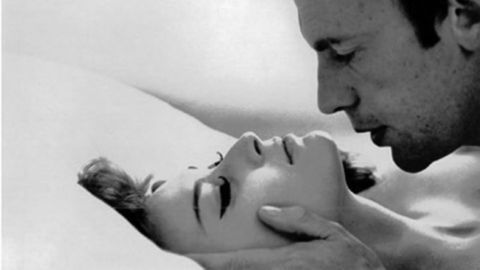
When Boris arrives at the rundown castle home of Jean to tell his sister, wife and maid of the man's exploits, they are more interested in lesbian business with each other, as if being without a strong male presence has made them homosexual. Again, could be a dose of humour, yet the emphasis on imagery of hands closing around throats indicated Robbe-Grillet had not quite gotten the sadism out of his system from his previous movie, and the maid does get slapped around by Boris as a prelude to lovemaking, which leaves an uneasy feeling. Then again, so much of this could have been included for the sake of obfuscation - breaking glasses, hair cut off, a photograph springing to life - that the temptation was not to sit down with the movie and make up a set of charts and graphs to fathom what he was on about, but more to let it all pass by, allowing selected interesting imagery to linger in the mind. With the ending of the story the beginning, these circular stylings were at least presented in striking black and white photography making it captivating to look at. Music by Michel Fano.