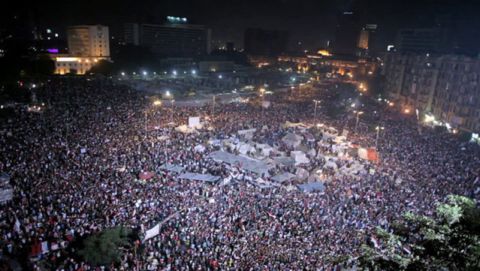
February 2011 in Egypt, and as was the same across much of the Arab world at the time there was revolution in the air. In this country that became centered on one public meeting point, Tahrir Square where citizens sick of President Mubarak's regime assembled to protest, inspired by others across the region. With the world watching, the dictatorship could not get away with simply using violence to disperse them without angering their allies, so the protest went on, growing increasingly strong until their demands looked as if they would be met. We follow a handful of these revolutionaries, including Ahmed who represents the youth of the nation, and British-born actor Khalid Abdallah who becomes an eloquent spokesman for the cause...
If ever a documentary left you with mixed feelings it was this one, detailing from the ground level the revolution in Egypt that sought to oust the oppressive leaders and instigate a fairer democracy that truly was of the people, only for it to be hijacked by forces which attempted to bring religion into politics, and then the military who were using their tactics to sow the seeds of destruction right where the protestors would be hit the worst. In truth, as director Jehane Noujaim did stick so close to the events on the streets, the bigger picture was often slipping out of focus, but fortunately she had chosen subjects who were literate enough to periodically keep us up to date.
One thing was clear in amongst these frequent lapses into chaos, and that was the citizens were not being represented by those with their best interests at heart, for it was power the politicians, the military and the hardline religious leaders wanted, and much of the story of three years of Egypt's battles was a struggle to control the population by these three groups. Indeed, it was as if the will of the people did not matter so much to them as much as enforcing the authorities' will on them, no matter that this all too often led to more violence and injustice. The number of times the leading players in Noujaim's narrative returned to the Square of the title to make their displeasure known was only matched by the number of times brutality was used to keep them quiet.
But the genie was out of the bottle, and many were not going to be suppressed by those who thought threats were the simplest method to get their way. The team of cameramen captured some alarming footage from the riots as the soldiers cracked down, not shying away from protestors callously run over by armoured vehicles, being beaten, gassed and even shot at, with images of injured and even dead bodies proliferating in some very disturbing sequences. But it could be moving as well, as the distress caused to the relatives of the dead was shown, for example one mother proud of her son as a martyr but wishing desperately he was still alive, the filmmakers ensuring we never forgot about the personal among the movement.
No mean feat when quite a few shots were of absolutely loads of Egyptians, mixing religions, ages, genders and social backgrounds, in that square as well as in other areas of Cairo. There was no call for establishing the location with picturesque views of the sun setting over the Pyramids or the Sphinx, this was a modern Egypt and it had a a number of problems. In fact, aside from the impressive visuals of the ordinary folk gathering to make their displeasure known and demand a genuine change, many of the most memorable shots were of the results of torture by the authorities, including popular singer Ramy Essam whose rallying tunes mightily angered them, leading them to imprison and beat him savagely. That they think this is acceptable behaviour in running a nation was bad enough, but the way that in spite of the demonstrations the same thing kept happening was none too cheering. Kahlid remains optimistic, reasoning that it may take decades but he's sure a real democracy will be achieved, and you hope he's right, but as I say, mixed feelings are difficult to ignore.