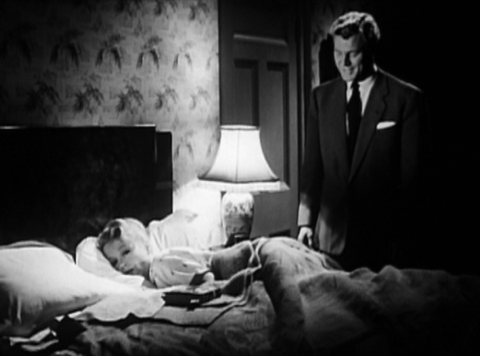
Another week, another boarding house for husband and wife David (Tony Wright) and Jean (Patricia Dainton) Linton, escaping their debts and clinging on to David's dreams of becoming a novelist to make ends meet. Currently he raises cash penning reviews while Jean takes a succession of jobs, yet they are still short of funds, and flitting from one place to another, owing rent and David's increasing attraction to the bottle is no way to live, but one day Jean picks up some mail and finds a letter from a solicitor. It tells her she has just inherited a large country house: finally, a stroke of luck! She is delighted they will have somewhere to stay at last - but what if they are not alone in their new home?
The American title for The House in Marsh Road was The Invisible Creature, which made it sound far more sensationalist than what we actually got, which was a rather quaint ghost story with the creature in question not some being from outer space or an uncanny, ravenous beast but your common or garden poltergeist. Even so, this unwelcome tenant wasn't a huge part of this hour-long British B-picture until the very end, as the plot was more of a murder thriller in a grand tradition of such things, not exactly what Agatha Christie would have conjured up for there wasn't much of a mystery element, we were simply biding our time to see David receive his comeuppance.
After moving in, the couple start to experience strange goings on, such as members of the film crew pushing a chair across the floor, or dropping a plate from a wall, all as cheap as you like and far from scary, if oddly a little more accurate to most actual tales of hauntings than the sort of over the top display you would have seen in, well, Poltergeist or any of the works which followed in its disembodied footsteps. Jean is now content living in the building she always liked as a girl, but David begins to show signs of being a wrong 'un as he asks an estate agent (Sam Kydd) how much he could get for the old place and obviously doesn't wish to hang around there for the rest of his days.
Maybe the writing will take off, or maybe something else will be taken off as the secretary he hires to type out his novel proves something of a temptation. Moviegoers of the day might have forgiven David for this when they saw she was played by Sandra Dorne, a pin-up of the nineteen-fifties who is largely forgotten now as one of a succession of platinum blondes who habitually showed up in bad girl roles throughout the decade. She was neither the most talented nor the biggest name of them, but she did have her fans and may have made more of a lasting impact if she hadn't spent most of her film career in B-movies. Funnily enough, Wright was also considered quite the hunk at the same time, making them a neat match onscreen.
Soon the allure of scribbling and typing has worn off and David and secretary Val are having an affair - the script makes sure we know Val is a divorcée, which apparently is meant to colour our perception of her as a loose woman, and surprisingly for a work of this era, we see them both in bed together late on, he wearing his pyjama bottoms and she - gasp! - wearing the pyjama top, leaving us in no doubt of what they had been up to. Patrick the polt (as the housekeeper calls him) isn't having that, and makes his displeasure clear when Val looks into a mirror and it breaks, so he is on Jean's side all the way, which is just as well when the illicit couple are planning to bump the poor wife off. Yet Patrick keeps foiling them, which makes it more difficult for Jean to convince folks that there is something going on and her life is in danger for she has to explain the supernatural element which cues them to thinking she's making it up. Leave it to the ghost to take revenge in a fiery finale which shows where the budget went. Music by John Veale.