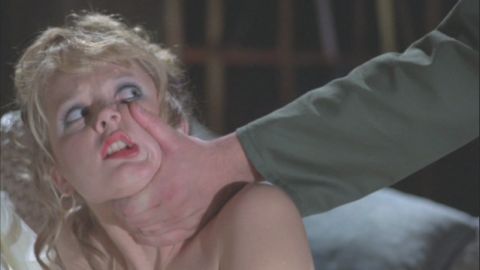
One night near the Lanier College, a student couple were parked next to the lake when they begin to get amorous in the darkness of their car, though the girl is not sure she wants to go all the way in these cramped conditions. She tries to persuade her boyfriend to take her somewhere more comfortable, but he doesn't wish to wait and continues kissing her until she asks him if he loves her, which is far from the kind of conversation he was wanting right now. He manages to reassure her, and they climb into the back seat whereupon she thinks she hears someone outside; the boyfriend dismisses this suggestion until something lands on the car roof and they yell, trying to get away from a madman...
Well, who'd have thunk it? Starting out as if the screenwriter, who was also director Jimmy Huston, had heard one too many urban myths, Final Exam was an attempt to lend a little depth and shading to what had quickly become one of the most clichéd of genres by 1981, the slasher movie, so much so that after the first two kills of the couple in the introduction, nobody else is offed for nearly an hour of screen time. This gave the audience the chance to get to know the characters, their likes and dislikes, their personalities, their - um, who really cared when what that audience really wanted to see was their gory demises? So Huston's heart was in the right place, but he was rather foolhardy.
This had the consequence of making Final Exam a movie for the true connoisseur of the slasher, not because it was particularly good, but because you had to appreciate what they were trying to do by subverting the form after watching so many examples so close to be identical. When Wes Craven and Kevin Williamson teamed up for Scream, they got away with their knowing approach mostly because they remembered to stick with various conventions just as they pored over them and sent them up simultaneously. With this item, Huston remembered all the suspense and violence, but left them till the last half hour, which was just too long for an impatient viewer.
What it did was offer a chance to see what a slasher movie would be like if none of the characters were getting killed, something unique from the era this was released, and inadvertently revealing exactly why they were simply not compelling enough to be put under such close scrutiny when they fitted a type more than they did a three-dimensional persona. Did we actually want to learn more about how the final girl, the nerd, the jock, the bimbo and so on went about their lives before the maniac arrived? Probably not, and this showed you why; its heart was in the right place in wanting us to like the people we were spending time observing, but Huston was not skilled enough as a writer to offer them much of interest to do other than carry out a few college flick clichés.
Those clichés - aside from a staged mass murder prank - could just as easily have slotted into a teen comedy of the eighties as they did a horror movie, which was telling without anything compelling carried out with the conclusion. One notable aspect was Final Exam's bad guy, not a masked killer, not even someone with a grudge whose identity was revealed for the big twist at the end, he was just some bloke (Timothy L. Raynor) who stomped around bold as brass and using a kitchen knife in ways for which it was not intended. Nobody in the film recognises him, he doesn't speak to explain his motives, he has no personality himself, he's simply a force of death, and the most we get for an explanation is from nerdy Radish (Joel S. Rice, future producer of morally improving TV movies) who is constantly fretting that the maniacs and psychopaths are abroad in the land with no goal other than mayhem. So no explanation at all, then, though this did bring up the intriguing notion that all slashers take place in the same universe where the murderers are lurking. Music by Gary S. Scott.