The year was 1955, and young Harry Voss (Geert Hunaerts) loved to visit the cinema, often on his own. Today he was captivated by a fairy tale movie of a brave knight wooing a beautiful princess, which gave him an optimistic, romantic outlook on how his future relationships with women could be: the movies would not lie to him, would they? He was so caught up in the dreamlike atmosphere of the fable that on leaving the auditorium once the lights had come up, he sneaked over to the display of stills and stole the one with the princess on it. Back home, he asked his mother whether his father had swept her off her feet and spirited her away to win her heart, and to spare his illusions, she replied that he had...
The poet Charles Bukowski had conflicted feelings about the film industry, although his work was adapted for it a number of times, often with short subjects, over the years, but there was one production he felt comfortable with as the most accurate version of his writings, and it was Crazy Love, a Belgian first feature from director Dominique Derrudere. Some of the author's diehard fans would question that, but some people are never going to be pleased and considering it took a very identifiably American setting and story then transplanted it to the middle of Europe, it was at least as good as those efforts which stuck as close to the original locations as possible, one of which, Barfly, Bukowski had been involved in the writing of.
Not that he had anything good to say about that experience, but this mixing with movie stars like Mickey Rourke did provide a higher profile telling of his stories than Crazy Love did, both being released around the same time (in the United States it was retitled Love is a Dog from Hell). But while the down at heel poetry of his works was somewhat lost in the translation to a foreign language, you could pick up the gist of the piece and its themes of thwarted romance and the starry-eyed hopes of youth getting undercut and finally knocked out cold by the harsh realities of life: this was better than it could have been. Derrudere took three of Bukowski's stories, a couple loosely autobiographical and the last one you'd hope definitely was not drawn from life, and created an anthology of sorts.
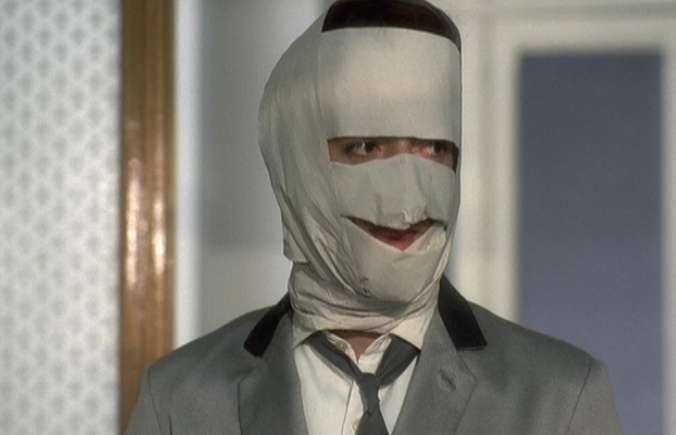
Belgian character star Josse De Pauw was Harry in the latter two tales, setting out what happened on the night of his final school day where he is meant to attend the dance but feels his horrendous acne means he will never be acceptable as a partner. Of course, he's right about that, though does come up with a temporary solution which gives him an aching, tantalising glimpse of what it would be like to experience the tenderness of women that he always aspired to when he was a child. In the meantime, he cannot lose his virginity when every girl is so turned off by his physical appearance, not even when his only friend tries to organise a coupling with one of the randiest in the school, but by this time Harry has already found his comfort.
Which is a bottle of whisky more often than not, so the third segment catches up with Harry as he is a drunken sot on another significant night at the age of thirty-three. He and another pal have been downing alcohol with a view to another evening of stupor followed by oblivion, which is the only thing that can make him happy, when they notice an ambulance taking away recently dead body. For a lark, and lacking the awareness that would tell them this is a very bad idea, they both steal the corpse in its bodybag and take it away to a rundown house which doubles as their drinking den. On investigation, however, the deceased is a beautiful young woman, played with typical sad irony by the actress who essayed the role of the princess at the beginning of the movie, and what happens next is either hugely depressing and melancholy or deeply disgusting, depending on your opinion - it could be both. The ideal of romance can be blamed by Harry for the degradation he wound up with, notable for remaining desirable no matter how wistfully destructive it is. Music by Raymond van het Groenewoud.