Rupert the Bear (voiced by Paul McCartney) feels the attraction of a country walk this afternoon, and tells his mother (June Whitfield) he's off to explore the hills near their home. She tells him to wrap up warm and sends him on his way, as he briefly pauses to greet his father (Windsor Davies) and steps outside the garden gate to be met with the sight of his friends Edward and Bill (both also McCartney) walking along the road. He invites them to accompany him, but Bill is pushing his baby brother in a pram and has to attend to him instead, leaving Rupert to go alone. It's a beautiful day and the little bear loves being among the flora and fauna, but then he notices something strange: a warning notice for frogs...
Was Rupert the Bear a polar bear, then? Having white fur and all? If so, what were he and his family doing living in an English cottage in the countryside? Anyway, this is not addressed in this cartoon, which was the brainchild of long time Rupert fan and ex-Beatle Paul McCartney, who expressed an interest in animation for quite a few times in his career, possibly impressed and influenced by what was achieved with Yellow Submarine back in the sixties. Here he collaborated with his then-wife Linda McCartney, also a cartoon fan, and director Geoff Dunbar to craft an accompaniment to his feature film Give My Regards to Broad Street. Oddly, that film flopped, but the short was a considerable success.
Broad Street did deliver a big hit single, No More Lonely Nights, even if few were going to see the film it originated in, but if anything the tune from the Rupert cartoon was an even bigger hit, being one of the catchiest things McCartney had ever penned. Yet with this success came a swift backlash among the serious music fans: The Frog Song was simply proof that of how the once-mighty musician and songwriter who had changed the world with the most influential pop and rock band of all time had dwindled into making pap for kids; basically Paul had lost it. Even now there are those who use this as a stick to beat him with, the epitome of the rock star whose talent deserted him as his career drew on in an inevitable pattern we had seen before and would see again.
But of course what these critics couldn't see was that for a start The Frog Song was a deeply sincere tribute to the Rupert character - this is dedicated to his creators - but also that it was a charming ditty for children, a concept that has dissipated in the years since as hit pop music tends to be for all ages, or all ages willing to engage with it, and a novelty like this is alien to the charts. Those who point out that you wouldn't get John Lennon pandering to the kids seem to forget his tune Beautiful Boy, which is just as sweet, yet more saccharine while The Frog Song has a genuinely eccentric quality that marks it as uniquely British while holding a universal appeal of cultural harmony elevating the Rupert character into something both apt and reaching beyond the quaint.
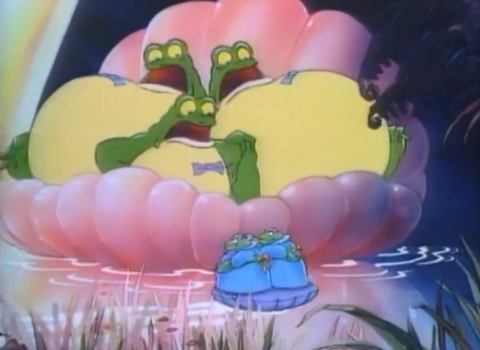
What Rupert sees when he investigates those signs is an assembly of amphibians (and a few other animals) taking part in an occasion that only happens every two hundred years (just to make it sound extra-special), a concert they all join in on in an exuberant display of song. Meanwhile, just as there were those resisting the winsome allure of McCartney's work here, there are sinister characters lurking, an owl and two cats looking on with malevolent intent though Rupert manages to foil their schemes in an opposite result to Tam O'Shanter's encounter with the witches in Robert Burns' famous poem. Rupert had been adapted to the screen before, the small screen with the seventies puppet show (also featuring a hit earworm of a theme tune) and the later, more traditional cartoons, but there was something about The Frog Song which captured the innocence and whimsy of the original stories that was very appealing, and wonderfully rendered in hand drawn animation. Highly idiosyncratic, but heartfelt: with McCartney long the focus of fan adoration, it was nice to see his enthusiasm too.




 Display comments