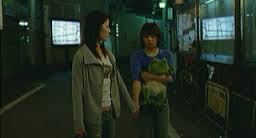
An enraged young woman named Akemi (Konatsu) abandons her cheating husband and flees into the night. At one of Tokyo's many comic book cafés she strikes up a friendship with sultry Kyoko (Rinako Hirasawa), an aspiring manga artist who supports herself by working as a prostitute. Upon returning home, Akemi finds her husband (Mutsuo Yoshioka) in bed with his girlfriend but calmly eats dinner in the kitchen listening to them having sex. The next morning she gets into a baguette battle with the skank that finally convinces her to move in with Kyoko. Together the girls share a tumultuous friendship fuelled by a love of sex, manga and a freaky fetish for furry frog costumes.
According to Japanese cinema guru Jasper Sharp, in his seminal study of the pinku eiga or sex film genre “Behind the Pink Curtain”, the title Kaero no Uta (Frog Song) is a pun referring to both the frog costumes and the Japanese verb kaeru: “to go home.” Thus the title could also be translated as “going home song” which befits the course of the plot. Originally released under the more salacious moniker Paid Companionship Story: Girls Who Want to Do It, Frog Song proved to be one of the most critically-acclaimed pink films in recent times, winning several major awards including best actress nods for likeable leads Konatsu and Rinako Hirasawa. Sex movies were always taken more seriously in Japan ever since the Seventies when respected film studio Nikkatsu started cranking out their so-called Roman Porno (romantic porn) movies that were glossy, well-made and widely embraced by the mainstream.
However, Frog Song was part of a new wave of pink films spearheaded by writer-director Shinji Imaoka, one of the so-called Seven Lucky Gods of Pink. Eschewing the sadism and misogyny long associated with the genre this new breed erred towards quirky slice of life comedy-dramas that were upbeat and life-affirming. Fetching starlet Rinako Hirasawa, making her film debut here, became a fixture of this new scene appearing in the equally offbeat and charming The Strange Saga of Hiroshi the Freeloading Sex Machine (2005). She went on to star in New Tokyo Decadence – The Slave (2009), a film based on her own early experiences in S&M porn that won her a second best actress award. The sex scenes in Frog Song are as lengthy and steamy as one would expect of the pink genre yet Imaoka films them in an almost dispassionate, matter of fact style. While this did not sit well with pink film die-hards like cult director Takashi Miike, who lamented what he saw as the loss of the genre's darkly perverse sense of humour, many viewers found this new heartwarming direction a breath of fresh air.
Frog Song is fundamentally the story of two fragile, emotionally damaged young women healing each other and learning to accept their lot in life. The frog costume becomes this goofy yet strangely affecting symbol of feminist empowerment. Both women start off with a low sense of self-worth. Akemi cannot break away from her two-timing husband while Kyoko foolishly tries to live up to her self-image as “no-good whore.” A few curious scenes do not sit well with the vaguely feminist message. Kyoko coerces Akemi to have sex with one of her clients and later seduces her husband. Imaoka hints that she does so to prove to Akemi her husband can never be truly trusted though her motivation seems unclear. These brief lapses aside the director successfully upholds the uplifting tone even after events take a darker tone when Akemi lets a client beat her up to earn the money she needs to buy a new apartment and Kyoko undergoes drastic surgery. Going against the western perception of manga and cosplay as nerdy fringe activities, the film depicts this oft-misunderstood sub-culture as a means to forge life-affirming relationships. Frog Song's other claim to notoriety is that it is also a musical featuring a handful of exuberant numbers it climaxes with the entire cast in costume dancing in the street. A fitting end to a bizarre but oddly lovable odyssey.




 Display comments