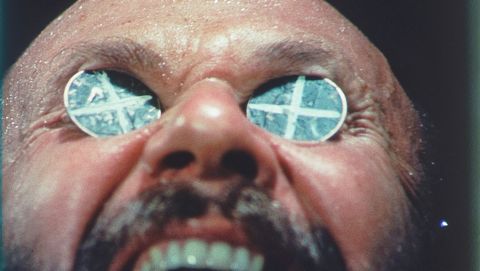
John Grant (Gary Bond) is a schoolteacher in the Australian Outback who would much rather be anywhere else than where he is. He teaches a small class of all ages in one tiny schoolroom, and now the Christmas and New Year holidays are coming around he is at least looking forward to getting back to Sydney and his girlfriend who he has not seen in months. He orders a beer at the village's only bar as he waits for the train to pull into the station across the way, the bartender (John Meillon) observing him somewhere between amusement and contempt though he still accepts his offer of a beer, and strikes up a rather one sided conversation - it'll be good to get back to civilisation.
Ah, well, fate has a habit of throwing a spanner in the works, which is precisely what happens here in Wake in Fright, directed by versatile Canadian Ted Kotcheff and drawn from the novel by Kenneth Cook which exposed a side of rural Australian life that was less than flattering. At the time, the film was widely praised for its gritty realism in spite of its heightened, at times near-hysterical tone, but after a few years it fell into obscurity, not helped by the way every print appeared to have been lost. So memories were all film buffs had to go on, and as time went by it was largely other people's memories, a poor state of affairs for a production which represented one of the first of the Australian New Wave in cinema of the nineteen-seventies.
Fortunately for those interested, a negative was finally discovered nearly forty years after the film had been completed and a wider release than it had ever had before was the result. But with this newfound exposure came controversy: some viewers simply could not get past the kangaroo killing sequence operating as the centrepiece, and that was down to the footage used not being simulated: those were real animals being slaughtered in shots taken by animal rights activists to highlight the issue. Quite how John ends up in this situation, both witnessing and participating in the kill, is a deceptively simple one. He stops off at the town of 'Yabba (a fictional place, but taken from actual regions) and after checking into the dingy hotel he makes the mistake of seeking the local nightlife to stave off his boredom.
A theme could be how the demon drink can land you in all sorts of bother, as once John has ordered a beer at the bar, it's the trigger for his downward spiral into degradation. Not that we sympathise much with the man, as he's constantly looking down his nose at the others in the story, but events grow so extreme that we wind up feeling sorry for him in spite of how terrible it has finished up for him, as if everything is geared towards rubbing his nose in the grime of life. Step one is that beer at the nightclub where he meets lawman Jock (Aussie stalwart Chips Rafferty) who insists on buying him more and more beers, then introduces him to the local pasttime of gambling on the results of heads or tails coin tossing. Initially he thinks this is a pathetic waste of time, but soon he is taking part.
Thinking he will be able to earn enough there to buy out his contract which has forced him to teach in the back end of nowhere, he bets all his cash and naturally loses the lot, leaving him with one dollar. Therefore in a cruel joke his try at getting away has only ensured he is going nowhere fast. Soon he is mixed up with folks who seem to have hospitality at heart, but are actually victimising John for sport, the point of which remains mysterious other than the pull of teaching teacher a lesson himself, and the nightmarish mood overtakes the film from then on. Donald Pleasence, no stranger to nightmares in the movies, appeared as a doctor who is a self-confessed alcoholic, one of his greatest characterisations in a career which too often asked him to fall back on cliché, and Jack Thompson, one of the faces of the Australian New Wave, made an impression as one yahoo who takes John on that hunt. It's a harrowing sequence, and probably overbalances the whole film now, but the rest of it is pretty vivid in its dragging the protagonist through the mire: it should be funny but isn't. Music by John Scott.