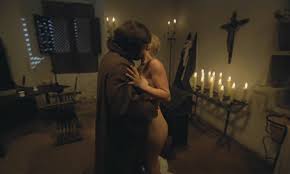
Following in the footsteps of Christ, the Devil (Paul Naschy a.k.a. Jacinto Molina Alvarez) adopts human form to wander among mankind in Medieval Spain, hoping to have a little fun making mischief and mayhem. After murdering a nobleman kind enough to share his food, the Devil adopts the alter-ego of Lord Leonardo and takes under his wing gawky peasant lad Tomas (David Rocha) after liberating him from his abusive blind master. Together devil and unwitting disciple roam the land spreading corruption and sin, often of the carnal variety involving several beautiful women, while reinforcing his belief in the despicable nature of humankind.
Critics that were once very sniffy about the horror movies of Spanish actor and screenwriter Paul Naschy have since re-evaluated them as significant works yet his efforts outside the genre remain unsung. Naschy himself considered El caminante (The Traveller), his third outing as a director, his finest achievement: a bawdy, satirical Medieval fable very much in the vein of Luis Buñuel or Pier Paolo Pasolini. Ambitious and accomplished with exceptional cinematography by Alejandro Ulloa - who shot The Diabolical Dr. Z (1965) for Jess Franco, Perversion Story (1969) for Lucio Fulci, Companeros (1970) for Sergio Corbucci and an array of visually accomplished exploitation classics from Forbidden Photos of a Lady Above Suspicion (1970) to Horror Express (1972) and The Stranger and the Gunfighter (1975) – the film has an apocalyptic tone more unsettling than any of Naschy's horror movies. But as a comedy it is not especially funny and as satire comes across somewhat muddled on a theological level.
“Man is the the only true evil being in creation. That is why the Devil's work is so easy.” So runs the Devil's mantra and yet very few of his victims come across as inherently corrupt, amoral or guilty of any great sin. In fact in many instances they seem rather tragic figures goaded against their will. He starts out seducing a poor peasant woman (Silvia Aguilar) whose crippled leg has left her neglected by her husband and insecure. Unfortunately, the morning after their night of passion Leonardo robs the sobbing woman at knife point then brands her ass with an upside down crucifix (“So long, slut!”) Then there is the lonely Aurora (Sara Lezana), a noblewoman fallen on hard times whom he convinces to sleep with him in return for saving the life of her deathly ill little daughter. She does not enter into this lightly and even weeps while they make love. Sure enough the next morning Aurora finds her daughter has died and realizes she sullied herself for nothing. Worse is yet to come as upon discovering she is pregnant, Aurora births the Devil's monstrous offspring whereupon she hangs herself. Are you laughing yet?
Some episodes prove funnier than others as when Leonardo feigns madness in order to swindle a nobleman and his wife or the sequence where he poses as the lover of an adulterous wife who has no idea her real boyfriend was slain in a swordfight. As usual Naschy the writer-director ensures Naschy the actor scores with an array of beautiful actresses who all disrobe for numerous lengthy love scenes culminating in a fast-motion orgy at a brothel seemingly influenced by a similar scene in A Clockwork Orange (1971), albeit tonally closer to Benny Hill. Later on Naschy stages an effectively upsetting montage making use of documentary footage as the Devil gives Tomas a vision of mankind's future which involves two world wars, the holocaust and the atom bomb falling on Hiroshima. As if to prove his point he ends up abandoning Tomas to life as a sex slave to a gay nobleman although the peasant has his revenge, playing Judas in this perverse parody of the messiah tale. Occasionally the Devil gets a taste of his own medicine being beaten by bandits or by a lusty gardener who does not appreciate his attempt to usurp his position as top stud at a convent full of naughty nuns. Bizarrely, the Devil proves especially frustrated and angry each time he suffers an incident that confirms his belief in the general rottenness of mankind. It is a comedy of cruelty with a scathing view of humanity as a whole that is a little too pat and sweeping. Naschy's talent as a filmmaker is undeniably evident but the film is crippled by attitudes that are pure Seventies counterculture: a belief that women are neurotic nymphos, the middle classes are beyond contempt and that radical sociopolitical agendas somehow justify violence, robbery and rape.