Seventeen years ago, one hundred and seven children graduated from an elementary school in these Japanese council housing projects, but while most of them went on to learn at the junior school, one boy did not. He was Satoru Watarai (Gaku Hamada), and he wasn't interested in anything that would take him out of the housing development he had lived in with his single mother, a nurse at the nearby hospital, from birth, reasoning he would never have to leave since the complex amply provided everything he needed for the rest of his life. He developed a routine where he would eat, exercise, study and socialise, but also do the rounds of eveyone's apartments to make sure they were all right every evening. But as the years pass by, life passes Satoru by as well, with more and more of that 107 moving away for pastures new...
See You Tomorrow, Everyone, or Minasan, sayonara if you were Japanese, took its title from the phrase Satoru's class would speak at the end of each school day, which both indicates the finality of his situation and his inability to move on with his life. For the first half hour or so, we think he's being stubborn and has closed his mind to progress, both his own and others', but then we discover there is a reason why he refuses to leave the projects and that is a deep trauma which happened to him as a younger child where a classmate was murdered in front of him. Ever since he has been terrified of the thought of moving away, as if stuck in the pre-trauma phase of his time on Earth that he doesn't want to end, thus prolongs it as far as possible.
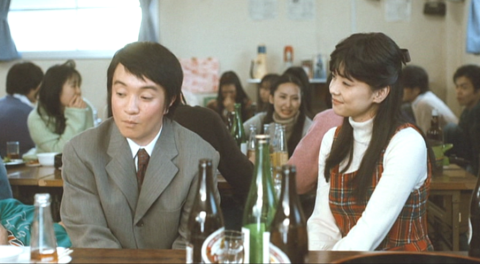
But of course it has ended, and the further this episodic film goes on - each part is heralded with a caption telling us how many of Satoru's class have left, the number dwindling the more time goes by - things do indeed move on in spite of the protagonist digging his heels in. Of course, some people are happy to stay in much the same place all their lives, but here it's a mental illness, as illustrated when Satoru tries to walk down the long flight of stairs to the street and the rest of the world only to find he physically cannot and collapses in a crippling panic attack. In the initial scenes he has people around him who can indulge his quirks, such as the girl next door Yuri (Haru) who he converses with over the veranda and receives more than one home truth from, not to mention sexual favours which are mutual, though she refuses to take his virginity.
He does get engaged, not to Yuri but to Saki (Kana Kurashina) who professes never to want to leave either, but is simply being polite and eventually she breaks it off when she finds someone who is willing to travel a bit more than one square mile. As for a job, Satoru believes he can make his way with a position at the cake shop, yet even that is placed in jeopardy when his ageing boss begins to lose his faculties, and the theme of the bright future Japan imagined for its new housing efforts falling away into neglect and disprepair is hard to ignore, as director Yoshihiro Nakamura allows it to dominate. The last act sees Satoru turn hero as his physical regimen comes in handy when he befriends a young Brazilian immigrant girl (Naomi Ortega) who is being abused by her outwardly friendly but coldhearted criminal father and plans to sell her into slavery since she is his stepdaughter; in a film that's probably too long and overemphatic in its message, this development of one man taking a stand against the creeping turpitude is worth waiting for, and Hamada makes for a frustrating but well-meaning character to follow. What could have been goofy has a quiet dignity. Music by Goru Wasakara.