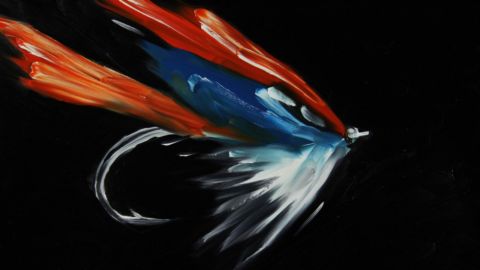
Megan Boyd is a legendary name in salmon fishing circles, and that is thanks to her uncanny ability at tying fishing flies, which had caught countless fish in the decades she had been crafting the small objects. She always said she tied them for the anglers rather than the fish, for nobody knows why salmon take the bait since they do not feed on their way back through the fresh water rivers on their way to spawn, only when they are in the oceans. Megan worked from her tiny cottage on the North coast of Scotland, and was self taught from a instructional book she had consulted as a young woman, but her knack with creating the finest examples of the art attracted customers near and far, from all walks of life...
Megan Boyd is not a name which will be at the forefront of most folk's minds, but sometimes the most unlikely subjects for a documentary can surprise you, and so it was with Kiss the Water. The director Eric Steel had become notorious for his previous work in the field with The Bridge, where he filmed actual suicides jumping from the Golden Gate Bridge to much controversy even though he said he was attempting to highlight the issue rather than exploit it, but here the subject couldn't have been more different. Unless, that was you saw a connection between the suicide victims and the salmon who seemingly willingly went to their deaths by deliberately getting themselves hooked.
That analogy was a stretch, however, and Steel explained his motives for making this at the beginning of the film, where he was reading the morning paper's obituaries and the story of Megan caught his eye, and indeed his imagination - the metaphor of being caught by something irresistable is one he continually returned to throughout, whether it be himself entranced by his subject, or the fish by the flies, or the anglers by Boyd's small objects of desire. This was not laboured and grew organically from the chat of the interviewees, none of whom were identified on the screen while they talked (not that anyone but their friends and family would be familiar with them anyway), as they described knowing the woman who would best be described as an eccentric.
Yet the more we hear of Megan, the further her story makes sense, mainly as an integral part of a tale that became increasingly elemental the further it went on. With many picturesque images of the Scottish countryside and its rivers, a curious peace settled over the film, and with its connections to nature it was easy to relax and feel at one with the environment, even at the remove of watching an admittedly placid documentary about it. Helping what turned oddly mystical were the animations by Em Cooper dropped in throughout, brightly coloured and ever-moving oil paintings which commented on and represented the themes of a certain magic that were only alluded to by those interviewed, but could convince the viewer were genuine.
There was only one aspect which overbalanced it into the realms of the farfetched, and you would imagine a British filmmaker would not have made this comparison, and that was when the subject of Prince Charles was brought up. He was a fan of Boyd's creations for his own fishing, and Steel saw fit to include news clips of Princess Diana to put across the idea the future King had hooked her as he would have done a salmon, which not only was a trifle silly but Steel would have been better off using images of Camilla if that's the detour he wished to take. On firmer ground were diversions such as the woman who caught the record-breaking salmon in Scotland, a mere amateur whose first time use of Boyd's fly was, it is implied, instrumental in her huge catch. It was somehow fitting to learn Megan, who never married, was resistant to fishing herself because she couldn't bear the thought of killing the creatures; of course, most anglers, unless they wish to eat the salmon, put them back after they've landed them, but that was one detail among many of a captivating tale. Music by Paul Cantelon.