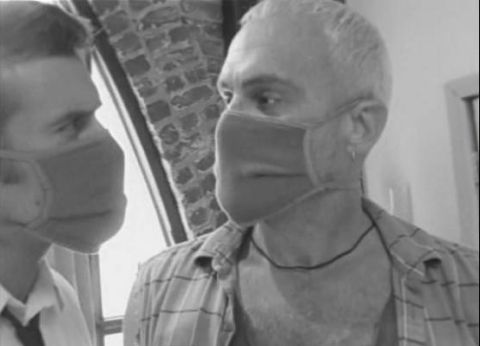
Carl (Bruce Campbell) gets out of prison today after a five year stretch and the warden (Art LaFleur) could not be happier since he has seen a great improvement in him after arriving all that time ago as a punk with no prospects. As they sit in the warden's office enjoying cigars as a small celebration, Carl is asked what he plans to do now, and replies that after his experience in the jail's laundry room he will be going into that business on the outside. The warden is very pleased and sends him on his way, but what he doesn't know is Carl has a heist planned, one which he has been scheming for all this time. Not only that, but the crime will take place within minutes of his release...
Appearing to shoot a film in one take is something that the director of this, Josh Becker, was well aware had been tried before in Alfred Hitchcock's Rope, though Andy Warhol's lengthy experiments in the sixties owed something to that as well, and soon after Running Time was made a movie made in one actual ninety minute take was crafted in Russian Ark, but that was exploiting the ability of digital camerwork. In this case, Becker was forced to break up his effort into various takes where the cut was hidden by clever editing to give the illusion that what we were watching was in one continuous shot, much as Hitch had done. But there's a problem when that was sold as the production's chief selling point.
Which was that unless you were engrossed in the plot, you're going to be spending most of the movie distracted looking for those cuts and how they were disguised. In one way this was to the film's benefit as you would be offering it your full attention, spotting the bits where the actors would get close to the camera and it all would go black for a second, or noting the whip pans between them which would also hide another edit, but that might well mean unless the narrative was truly strong you would be losing interest in the usual aspects of watching movie that would traditionally engage: character, emotion, humour, stuff like that. Fortunately, Becker had his old pal Bruce Campbell for his leading man, a performer who could bring all of that to the table.
Becker and Campbell had first worked together on a feature with The Evil Dead, that seminal no-budget horror that shook up the eighties, and you could tell they were comfortable with each others' styles which was just as well with the criminal antihero the centre of attention for the full seventy minutes. Maybe Campbell didn't get much of a chance to show off his comedic skills, though he has the odd funny line, but he was charismatic enough to carry a storyline that was rather anaemic for a movie genre that had, by the nineties, been done to death and was still being flogged by indies and majors alike. If this was the decade where everyone in the industry seemingly wanted to give a heist a try, then you really needed something to stand out from the pack.
Running Time was most like one of those fifties B movies with its brief, er, running time and conventions of the plan going wrong and a dose of romance for the protagonist as we had to feel he had something to lose, and the love of a good woman was as useful as anything to that plot. In this case she was Janie (Anita Barone), the prostitute Carl meets in the back of the van of his partner in crime (Jeremy Roberts) and has a surprising quickie with only to realise they went out together in high school until an unfortunate break-up and haven't spoken since. She gives him her card on her exit from the vehicle, which will come in handy for the finale, then it's on with the robbery, though the masks the criminals use don't really conceal who they are too well. Naturally nothing goes to plan, which should have amped up the tension but it was what we were expecting after seeing quite a few of these movies before, so it was catching those cuts we were most entranced by. Yet ambition on a low budget was not to be sneezed at, and this was too short to outstay its welcome. Music by Joseph LoDuca.