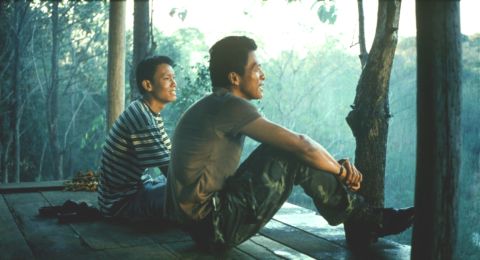
Keng (Banlop Lonmoi) is a soldier who has been on patrol in the wilds of Thailand, where he and his fellow troops stumbled across a dead body. Obviously, the first thing they did was take a few pictures, not only of the corpse but of them posing and smiling with it too, then bundled it up and set about carrying it to the nearest civilisation, though they are not averse to stopping off at a small house where they socialise with the occupants and stay the night, well aware that the dead body will begin to bloat up and decompose the longer they hang around. What Keng is most interested in, however, is his best pal Tong (Sakda Kaewbuadee), who he feels quite a strong attraction to - but is the feeling mutual?
Local boy Tong certainly likes Keng well enough, but the odd impression is that he is merely being polite when the soldier is with him, flattered by the interest shown but not willing to reciprocate with actual love and romance: sex doesn't enter into the relationship either. Or does it? There was a lot inscrutable about writer and director Apichatpong Weerasethakul's film, his first to really make a big splash internationally, winning much praise at Cannes, for example. But then he was not a moviemaker to make plain every point and theme of his work, which led many to apply their own interpretations of what he was getting at, some more convincing than others.
What was clear was this was a story about love, and how that love can sometimes go unrequited even when there is affection there, but for whatever reason it cannot be taken any further, as Tong remains very much closed off to both us watching and Keng who plainly adores his company. Sure, he will smile and make conversation, go as far as allowing Keng to rest his head in his lap or playfully indulge his knee massage in a cinema, yet you're never thinking that Tong is entirely giving himself over to his mate, always at a remove - is it significant we watched him make moves to flirt a little with an attractive woman on the bus before he was interrupted by Keng? Maybe he just respects the military.
This duo's tale unfolds at a leisurely pace, and even at around an hour long there is more happening in subtext than ever happens in the plot: the boys putter about on a motorscooter, visit a concert in the open air (and even participate in a goofy sequence), investigate a shrine in a huge cave network, chat amongst themselves and other people, leaving us to bring our own ponderings as to what it all indicates as very little is given away. But if that was difficult to fathom, then what were we to make of the second half of the movie, which starred the same two actors but in apparently different roles? Though how different were they? Keng is still a soldier, and Tong is still the object of his desire, except now is he truly out of reach since he is actually a tiger. Or rather, a tiger spirit who could change into human form.
Needless to say, the director's eye for the beauty of nature, specifically the nature around Thailand, was already at this relatively early stage in his career very well developed, with the landscape of the place as much a part of the story as the characters, at times overlapping with animals given voices that can be understood by sympathetic chaps like Keng. Or perhaps he's gotten so far into his search for the killer tiger that he is beginning to flip, and perceive the beast's desire to consume him less as one would a dish of meat, and more on a romantic, even spiritual level. If you thought part one was slow, that's nothing compared to part two, which ekes out increments of narative in a manner that to all intents should have given us time to understand it, yet its blankfaced revelations were just as open to personal explanation as what had gone before. It may be that Tropical Malady, or Sud pralad as it was originally known, was so personal - to its creator, that was - that any outsider would never quite cotton onto its meaning. Whatever, it was oddly mesmeric.