There's a parcel which has arrived in the post for Terry (Jack McNicholl), it was addressed to his mother really but it is a present for his birthday this weekend. He is delighted with the stylish shirt and wants to wear it to school, yet his mother has reservations and tells him to take it off and keep it for his party, however Terry has other ideas and rushes out of the house without teling his mother he is still wearing the shirt. When he gets to his school, he is the talk of the classroom for his new threads, but on returning home after class his sister Tracey (Tracey-Ann Morris) tells his mother what he's done which leads to a blazing row and Terry running away...
Terry on the Fence (that title is explained by a scene late on in the film) was one of the final efforts from The Children's Film Foundation when its regular output of a few works a year had dwindled to almost nothing - pretty soon it would be nothing at all, which left this on the fence itself between the old style of entertainment and juvenile adventures that the foundation was known for and trying to seem relevant in the nineteen-eighties when American product was flooding the market and making a far more attractive option for the young cinemagoers of Britain. Therefore it was a rather sad little coda to what had been a highly successful run, more or less, that Terry represented.
As if recognising this, the drama itself was an ashen-faced affair which looked a lot less vital than what had been broadcast to the nation's homes every week in children's soap Grange Hill. That programme was of course not allowed to be watched in certain households by parents fearing their little darlings would pick up bad habits, but surely the C.F.F. was a safer bet? Yet Terry on the Fence was practically Goodfellas in comparison to the majority of the outings under that venerable banner with its tale of a criminal gang and their reign of terror over a quiet London suburb (as ever, actual locations were used as much as possible). That's who Terry meets when he rushes out of his house to escape to the common nearby.
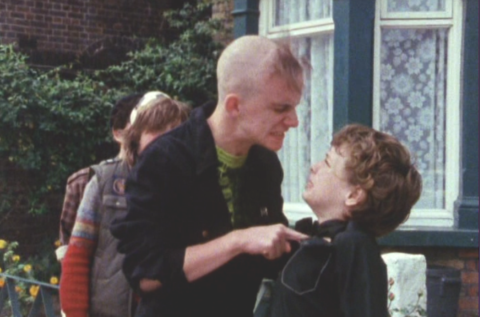
A thunderstorm breaks out so he seeks shelter in a graffiti-covered bandstand (or it's referred to as such in the dialogue, doesn't look like one, mind you), whereupon to his horror he is set upon by that gang of five ruffians, led by the punk Les (future DJ Neville Watson), an only slightly more convincing incarnation of a punk than you would get in the John Hughes movies of the day. Les has some trappings of a hardman, such a scar on his neck he scratches when nervous and an unusual hairstyle, shaved at the back and sprouting at the front, but then his cohorts mention his mum gave him the scar and you wonder if she gave him the haircut as well. Also in the gang is the memorably-monikered Plastic-head (Brian Coyle), so called because he sports half a football on his bonce.
Anyway, Terry is captured by this lot who force him to break into the school and make off with two radios from the headmaster's office, a plot point inspired by a real break-in at the school of the author of the book this is based on, Bernard Ashley, and now the protagonist is in real trouble. Will he own up or is he too scared by the influence of Les and company? This was not all black and white morally, as the main villain is seen to be rather weak when it comes to his mother, even breaking down in tears when she starts slapping him about, and Terry himself has ambivalent reactions towards his tormentor which actually has him feeling sorry for him by the end of the movie. There was more to this than met the eye, then, and it was effective within those parameters, but hearing the watered down dialogue as Tel is called "wally" and "pigface" leaves it unconvincing to a point, not that they could have used anything stronger considering the target audience. It would probably have played much younger than intended even in 1985. Music by Harry Robertson.
[Terry on the Fence is released by the B.F.I. in one of their Children's Film Foundation DVDs entitled Runaways. It's part of a triple bill with Johnny on the Run and Hide and Seek and includes a booklet of informative essays.]