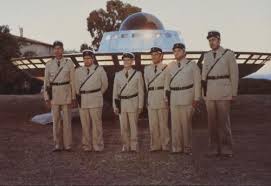
Inept police chief Ludovic Cruchot (Louis de Funès) and his equally idiotic officers patrol the sun-drenched beaches of Saint-Tropez making life very difficult for their long-suffering superior, Gerber (Michel Galabru). One day, clumsy fat cop Beaupied (Maurice Risch) spies a real-life UFO flying off from the woods. At first no-none believes him but later Cruchot has a face-to-face with one of the clanking extra-terrestrials that drink oil, shoot laser beams from their eyes and have the power to shape-shift into anyone they want. Even though the aliens assure Crouchot they come in peace, the panicky policeman sets out to expose their existence but succeeds only in making himself look crazy.
Although science fiction and fantasy fare rank among the biggest blockbusters in English speaking countries, in France the highest grossing films tend to be comedies. In the case of Le gendarmes et les extra-terrestres the combination of both yielded the most profitable entry in the long-running comedy series that began with Le Gendarme de St. Tropez (1964). These lightweight farces were vehicles for the talents of one of France's most beloved comic actors, Louis de Funès who first found stardom in Pouic-Pouic (1963) which was also directed by frequent collaborator Jean Girault. Aside from headlining such other phenomenally popular French comedies as Le grande vadrouille a.k.a. Don't Look Now - We're Being Shot At! (1966), de Funès remained a fixture of the Gendarmes series right until the final entry, Le Gendarme et les gendarmettes (1982). There likely would have been further sequels had he not succumbed to a heart attack in 1983.
Unlike the dry wit of Francis Veber or the poetic pantomime of Jacques Tati, the comedies of Louis de Funès veer towards extremely broad farce. Which is not to suggest he was incapable of making comedies of substance – such his collaborations with the great comic auteur Gérard Oury, notably The Adventures of Rabbi Jacob (1973). By and large though his humour tends to be as much of an acquired taste for non-French speakers as the Carry On are for anyone outside Britain. By the late Seventies de Funès was looking distinctly long in the tooth but on this evidence still had energy to spare. His manic mugging compensates for a plot that proves leisurely and repetitive. The film's science fiction angle seemingly takes its cue from Jack Arnold's seminal It Came from Outer Space (1954) but does little with that potent plot. The UFOs are simply a pretext on which Girault and his co-writers (including de Funès himself) hang a series of ridiculous skits. Some genuinely amusing, including an extended sequence with Cruchot disguised as a nun, others simply tiresome.
For reasons none too clear the shape-shifting aliens disguise themselves as gendarmes or else sexy bikini girls to make out with human beings. Which inevitably leads Cruchot to mistake hot beach babes for aliens and being denounced as a pervert or stabbing his boss in the ass upon falling for an alien ruse. Given the aliens plainly state their intentions are peaceful (one of them even offers Beaupied a bouquet of flowers), the gendarmes come across as reckless idiots in provoking them into threatening all of St. Tropez and, by proxy, the entire planet. Perhaps that is the point. After all, in France the gendarmerie were figures of fun long before Hollywood began lampooning them with Inspector Clouseau. Girault and de Funès mock them as anal and incompetent pen-pushers though it is clear they regard these buffoons with a degree of affection. The film exhibits a mildly satirical edge with its attack on advertising. A montage shows blurbs and slogans cluttering up the streets of St. Tropez, even plastered on the backs of a newlywed couple, but proves to be another throwaway gag. One of many scattered throughout the film that go nowhere. Interestingly this would not be de Funès sole flirtation with sci-fi. He tangled with aliens again in Le Soupe Au Choux (1981).