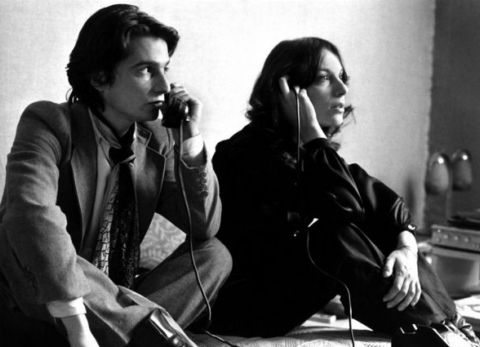
Alexandre (Jean Pierre Léaud) lives with his girlfriend Marie (Bernadette Lafont) in a one room apartment in Paris, but he has a roving eye for the ladies and has been romancing another woman, Gilberte (Isabelle Weingarten) on the side. He's never satisfied with just one relationship is Alexandre, and so this morning he borrows a car and drives off to the university where Gilberte is about to start her classes and confronts her, ordering her to leave the man she is engaged to and marry him instead. She listens patiently to his reasoning, but eventually turns him down; perhaps she knows him too well, she's heard it all before, and though she is fond of Alexandre she wants out of his life...
When you spend a bit of time in his company, you well see why Alexandre might not be the greatest guy to be around; he's pretentious and utterly selfish, not such a great combination and not one which you would expect to attract many women. However, as was the case with many of Léaud's movies, he was playing the surrogate of the writer and director, in this case the troubled, tragic Jean Eustache who in less than a decade had committed suicide, and if this film was anything to go by you might not be too surprised to learn that. Taking a view of love between men and women which was harrowing to say the least, although nobody lifted a hand to anyone else they might as well have done.
It was emotional devastation we were dealing with, as a bunch of characters who thought they had life all sorted out and knew their own minds very well find that the moment they open themselves up to romance - if you could call it that - they are starting a journey through a minefield, a war zone if anything. Essentially the tale of a love triangle between Alexandre, Marie and the new girl on the scene, nurse Veronika (Françoise Lebrun, Eustache's ex in real life), the various permutations they went through took a disparaging look at the very idea you could connect with anyone at all in the world of the nineteen-seventies. That point in time was important, and this is often named the final Nouvelle Vague work, coming three years after the sixties had exploded and finally fizzled.
All that promise, all that liberation the previous decade had served up was by this time dwindling into self-obsession and poor choices, the near-revolution of the May 1968 riots a legendary period which might as well have been a century ago for all the good it had done the young characters we watch now. For Alexandre's unlikeable friend, it's the Second World War that holds his attention, that dark era feeling more relevant than the unfulfilled potential that his generation was supposed to have turned around so dramatically, and now there's nothing left but try to stay modern in their outlooks. This is, according to Eustache, the road to doom and despair, because the current concerns that have replaced the older values are so wrapped up in themselves that they cripple the people who would be more likely to be taking advantage of them.
Therefore no matter how many sexual partners Alexandre and Veronika have, nothing will cure the aching chasm of their soul's malaise, and Marie, supposedly the sensible one, is dragged down into that with them, even attempting to kill herself on impulse before her boyfriend makes her throw up the pills she's taken into the toilet. It's not too controversial to say that The Mother and the Whore, or La maman et al putain if you spoke French, was not the easiest of films to sit through, being pretty much nearly four hours of intense conversation with nary a moment of relief throughout its elephantine running time (though a hollow laugh may be heard occasionally). That talk did give rise to a few nuggets of wisdom, although what most people remember would be Lebrun's long monologue near the end which was one of the sweariest ever as the realisation of her dreadful existence hits home, and the pointlessness of sex, with all its prejudices and traits, has her question her reason for being. Three lost individuals who cannot help each other, stuck together anyway: misery's not the word for it.