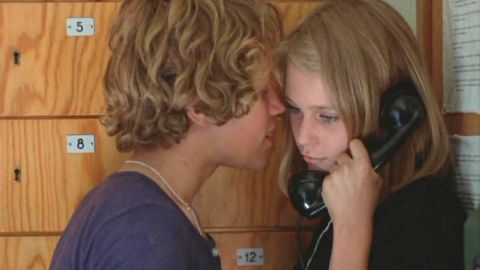
The time is the long, hot summer of 1969 and the place is Sweden, where young Par (Rolf Sohlman) has a job for the season in a garage, assisting the mechanics. Today, after watching the resident joker practice his kung fu moves for the benefit of his workmates Par heads off to meet his grandfather (Gunnar Ossiander) who has been admitted to a sanatarium out in the country. His parents are keen to cheer up the old man, so take him on an organised picnic where in the queue for food the boy has been sent to wait in, he notices a young girl of his own age who he is immediately attracted to. Is the feeling mutual?
Why, yes it is, but this portrait of young love - the protagonists are thirteen and fifteen years old - was contrasted in its innocence and lyricism with a far bleaker illustration of what the two youngsters have in store when they grow up a few short years from now. This was the first film from acclaimed Swedish director Roy Andersson to gain fairly wide recognition, with many of his countrymen considering it a minor classic of their nation's cinema, though that would depend on how far you related to his cynical look at the perceived purity of these teenagers' relationship eventually curdling when the realities of the adult world became impossible to ignore.
For this reason, A Swedish Love Story, or En karlekshistoria as it was originally known, was not as twinkly and sweetnatured as some seemed to remember it, unless they were concentrating on the young love and ignoring the horrors of what happens to the grown-ups. We get an inkling that all is not well when Par's grandfather breaks down and complains mournfully that this is no world for the lonely, and the image of a tearstained face is one Andersson returned to throughout, not only on the kids but on the adults as well. Not that Par and Annika (Ann-Sofie Kylin), playing the girlfriend, sees the path of their romance run smooth, as he has to endure the humiliation of getting beaten up in front of her.
The relationship recovers, but not until a degree of heartache even if we should be cheered they were able to put it behind them, yet that Andersson dejection which characterised his later, more famous works was not entirely absent - it wasn't absent at all. While Par and Annika make excuses to see one another, their parents and older relatives are wallowing in misery, with her father John (Bertil Norstrom) in particular telling all who will listen he is a bastard, as if that excuses his bad-tempered behaviour which has alienated his wife. Annika's aunt Eva (Anita Lindblom) too is having trouble making it through her life unscathed, as she admits uselessly to her niece how lonely she is, aware the girl can do nothing to help her even if she did offer a shoulder to cry on.
Andersson's later efforts were characterised by a surrealism and dark humour of the absurd, but there's little of the former here as he was more influenced by the New Wave cinema spreading across Europe at this stage; actually it had already spread and neared a conclusion by the point A Swedish Love Story was released, leaving it rather after the fact as that movement too grew into different forms and experimentalism was sidelined. That was not to say there were no moments of humour in this whatsoever, it simply helped to share the downbeat sensibility of the director to truly relate to it, assuming you were not caught up swooning with the romance. Actually, by the last act Par and Annika are noticeably absent, off in their own world, as the adults reach a crisis point that leads to a comical anticlimax, leaving us in no doubt that the central couple have nothing to look forward to but turning pathetically ridiculous. For a movie recalled for its sweetness, Andersson's best efforts proved unsettling should a straightforward love story be what you wanted. Music by Bjorn Isfalt.