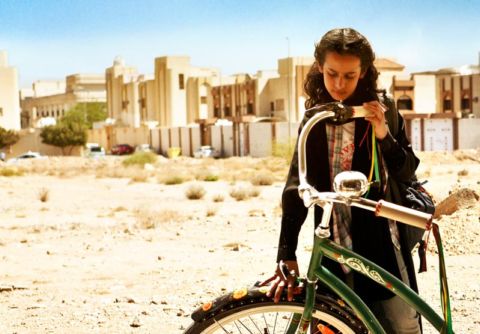
In Riyadh, Saudi Arabia, ten-year-old Wadjda (Waad Mohammed) lives with her mother (Reem Abdullah) and occasionally her father (Sultan Al Assaf), only he is more likely to be away from his family, and not just because he is working, but also because he is seeking to marry again. He loves his daughter, but the fact remains he would rather have a son and he doesn't believe his wife can provide him with one, so is looking elsewhere. But Wadjda has concerns of her own, as the boy she knows, Abdullah (Abdullrahman Al Gohani) enjoys teasing her and she is set on getting her own back, but how can she do that when she cannot even catch him on his bike?
How about getting a bicycle for herself? It sounds like a simple enough task, even if she does have to save up for it, but there remains a snag in that this is Saudi Arabia and there are restrictions on what females can do compared with men: many are not allowed out without a covering for their heads, they're not allowed to talk to men outside their immediate family, they're not allowed to drive and they certainly are not allowed to ride bikes in case they get a bad reputation for breaking a social taboo, so you can see why Wadjda is facing an uphill struggle to get her hands on the transport. Her parents are no help, so it's up to her enterprising skills of money raising to get what she wants.
At first she makes and sells bracelets in the colours of local football teams, then acts as a go-between for one girl and her prospective boyfriend for cash, both of which get her into trouble with the headmistress of her school, Ms. Ussa (Ahd) who becomes her nemesis whenever Wadjda tries to rebel in a way that in other countries would not seem so much of a big deal. This obsession with keeping women in their "place" was illustrated throughout the film, and when you knew its background you could more than understand why. Though there was little in your face confrontational about this, in its quiet, unassuming way a needling quality made itself apparent through the character of its heroine and her determination not to conform to the rules she never agreed to.
That the lead was a little girl likely made it easier for the points to be put across, however subtly, as Saudi conservatives could regard Wadjda as a brat who would grow out of her one-girl revolution and liberals could appreciate her unspoken plea for progress in their kingdom. Not that anyone was under any illusions that director Haifaa Al-Mansour was going to change the world thoroughly with her work here, but she was making a significant move towards it since she was not only the first woman to direct a feature in Saudi Arabia (having to jump through various ridiculous to Western eyes hoops such as not speaking directly to the men in her film crew), but she was making a film in a country where there were no cinemas anyway.
So in effect, there was no public forum in her native land for the work to be shown, which did have you wondering if Al-Mansour was creating this more for foreign markets than she was for those back home. Nevertheless, Saudis receptive to the idea were able to watch it and for the most part there was a warm reaction, though it was really those regions abroad which were praising it, and rightly so for with its gentle humour and deceptively biting criticisms Wadjda was one of the better examples of world cinema, and its heritage rendered it all the more interesting. In the West the most you would get for a depiction of a Saudi character in pop culture would be a rich oil sheik, often as the butt of humour, or after the tragedies of September the 11th 2001 as terrorists since most of the killers on that day hailed from Saudi Arabia. On the other hand, here was a film from someone who knew the country, and could acknowledge its problems while still respecting its people; with young Waad playing the epitome of a fresh, reasonable, hopeful feminism it was easy to be won over. Music by Max Richter.