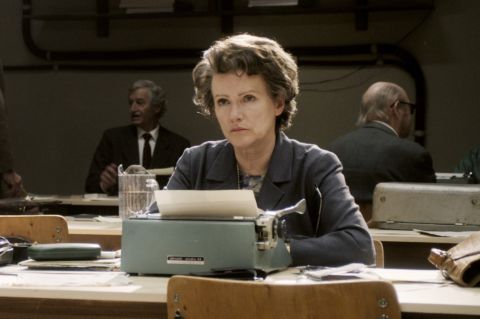
It is the early nineteen-sixties and the Nazi war criminal Adolf Eichmann has been kidnapped from South America and transported to Israel where he will be put on trial for his deeds. The world is watching with great interest, and among them the German intellectual Hannah Arendt (Barbara Sukowa), who has lived in New York City for much of her life since having to flee Europe when the Second World War began. Arendt was Jewish, so the editor at the New Yorker magazine thought it a good idea to persuade her to visit Jerusalem and attend the trial of Eichmann to offer her thoughts in a report. However, her findings were not what anyone expected...
If you mention the name of Hannah Arendt to most people these days, they will look a little blank, not recognising her or her achievements, but should you mention the phrase "the banality of evil" then more may well acknowledge they have heard that before; Arendt was the writer who coined that phrase. She used it to describe not only Eichmann (seen here in archive footage) and his ostensible bureaucrat's view of his activities, but the potential for evil in anyone who does not think about following orders which go against any moral grounds they really should have, or as a reasonable member of society should hold dear. That slide into sinfulness should not be so easy, but millions of Nazis carried it out without any apparent qualms.
Or so Arendt viewed the crimes of the Nazis, and the subsequent Holocaust of the Jews and others who were shipped to the concentration camps, but that was not all which was controversial about her articles and resulting book on the trial. Director Margarethe von Trotta was careful to make sure we knew exactly why so many people were hugely offended by what Arendt wrote, but the fact remained the film was on its subject's side, so no matter who is voicing objections to her, be they priggish eggheads or her closest, most supposedly sympathetic friends, we were clear that they were in the wrong and Hanna was in the right, even if she had not put across her points in an unambiguous fashion, essentially portraying the Nazis as an affront against the whole of a flawed humanity rather than the Jews alone, another sticking point (this says).
So for those who wanted to see Eichmann as the epitome of moral turpitude and vileness, Arendt's opinion of him as a bland pen pusher who lacked the perspective to see what a dreadful act he was pursuing, the elimination of the Jews, simply because of that banality in his character was an affront, not least because it humanised him and threw up uneasy issues that all too many could be capable of the same acts should circumstances contrive to put them in similar positions. And that included the Jews: in Arendt's article she pointed out that there were Jewish leaders in Europe who colluded with the Nazis, though the film does not delve any further into that subject other than to emphasise quite how the philsosopher became so ostracised and labelled with that dreaded epithet, the "self-hating Jew". You could not accuse the film of failing to state its central figure's case, as provocative now as it was back in the sixties, but as a viewing experience von Trotta and her team failed to truly make this come alive cinematically.
As if afraid that adding anything that could be mistaken for whistles and bells would undercut the messages, ironic with the face value judgement she took of Eichmann, this kept things subdued for much of the time whether in Hannah's home or lecturing life other than the impassioned speech at the finale. Therefore although you could reflect on it in an intellectual sense, as a movie it looked and felt rather drab, with Sukowa conveying Hanna's stubborness and convictions but somewhat lost in a haze of her chainsmoking as the other cast members orbited her. There was an attempt to open this out with flashbacks to Arendt's time as the lover of Nazi sympathiser Heidegger when she was his student, but mostly this consisted of conversations, and plenty of them, as you could see them as making excuses for what many still believe was inexcusable: a defence of evil. One thing this did was ensure we knew Hannah was misunderstood as her critics took on what they think she said to bolster their social position instead of what she did say: that remains sadly relevant. Music by André Mergenthaler.