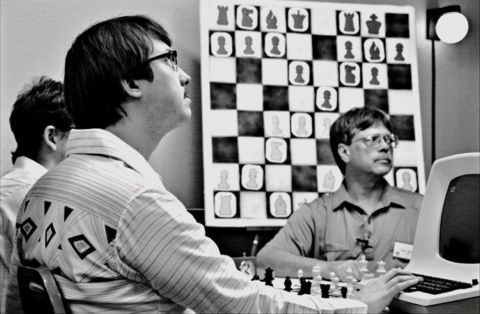
It is the early eighties, and computer science is advancing in leaps and bounds, so much so that it is possible for two machines to be programmed to play games against one another. And the perfect game of intellect, strategy and mental agility? Why chess, of course, which this tournament in an Austin, Texas hotel is being staged to showcase. There are a number of competitors from across the country who have spent quite some time pushing back the boundaries of what is possible in the sphere of technology by designing chess-playing programs, making this event the Olympics of the whole endeavour. But this weekend will contain surprises, and not all of them welcome...
Director Andrew Bujalski emerged from the American mumblecore movement, which seemed a difficult area to graduate from, making his Computer Chess all the more intriguing for adapting his accustomed techniques of mostly conversational drama to a plot which reached towards comedy, then science fiction, and as it drew to a close the downright bizarre. Working from his own script, he threw his hat into the ring of a genre of movies which appeared around this era where the main impetus for its style was not so much nostalgia, but a more keenly retro angle, joining such diverse efforts as the Oscar-winning silent The Artist, eighties blockbuster replicator Super 8 or the Chilean political recreation No which adopted the formats of yesteryear.
In this case Bujalski humorously depicted a bunch of what most films would classify "nerds" with some very primitive video cameras, the results being a sort of mockumentary, but then those sequences would break off into scenes and shots the documentary crew who are present at the contest would not have been able to capture, indicating a narrative hybrid was put into play. The idea that this subject could actually be really exciting was not necessary for enjoyment, though such was the dedication to authenticity with its era-specific cars, hairstyles, fashions, spectacles, and all the other trappings of a meticulous production design that you did wonder whose side the movie was on, thus it fell between the two stools of celebrating nerdism and prompting it into a crisis.
Whether this was saying anything about today through the prism of yesterday was a moot point, as you could watch the increasingly ridiculous occurrences with a sense of distance between you and the period on show, the look of the thing very much inviting that point of view with its indistinct black and white, muffled sound and basically the huge effort they had gone to in recreating circa 1980 in the United States. But there were bigger fish to fry here in that rumbling under the surface comedy - one sleazy character, Papageorge (Myles Paige), forever trying to get a free room by sleeping on the floors of everyone else's, for instance - there was something akin to a cosmic consciousness going on, suggesting what the programmers truly dreamed of was all too possible.
Which was? Their technology, their abstract creativity, could evolve that consciousness, and when one young boffin (Patrick Riester) starts to twig the chess programs are less keen on beating one another and more keen on beating human players we feel he may be on to something major. There is the odd shady figure around who may or may not be from the government, whose interest in artificial intelligence is presumably for "defence" purposes, sinister in itself, but the real power, the influence of the approaching future are those machines which will take over, at least because they will be so relied upon by humanity. So there was a nod to the present in that, but also the weirdness erupting as unforeseen or unacknowledged errors and flaws send things haywire: two characters get stuck in a time loop, an anecdote about a late night programming session turns creepy, and a New Age self-actualisation course taking place in the same hotel has odd repercussions, both philosophically and sexually. Definitely not for everyone (your patience may be tested), but in its subtle, allusive way audacious.