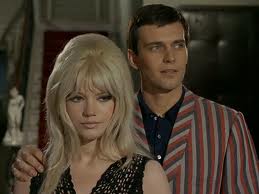
Five notorious international criminals - Klaus (Stan O’Gadwin) from Germany, Albert (Alex Morrison) from France, Juan (Ben Salvador) from Spain, Steve (Dmitri Nabokov) from England and Carina (Karina Kar) from Tangiers - meet up at a luxurious villa to divide a large number of stolen diamonds hidden by their deceased boss, Boris whose glamorous wife Anna (Maria Luisa Geisberger) is hosting the party. The diamonds are held inside an enormous safe and only the five keys Boris distributed among his collaborators can open it. Albert immediately angers everyone, not only by failing to produce his key but bringing along his pouting blonde girlfriend Jeanine (Cristina Gaioni), whom no one else knows. Tensions flare as the night wears on and one of the increasingly desperate crooks resorts to murder.
One of the great things about Italian giallo thrillers is their ability to cross-breed with other genres. In the case of Una iena cassaforte (A Hyaena in the Safe) the genre in question is the swinging caper move, another staple of Sixties cinema. Jules Dassin revived the caper movie on an international scale with Topkapi (1964) and the genre spread like wildfire throughout Europe adopting mod styles of fashion and filmmaking. Here, Milan based maverick filmmaker Cesare Canevari fuses a Ten Little Indians style mystery thriller with the trappings of the swinging caper sub-genre: pop art sets, a super cool soundtrack from Gian Piero Reverberi and fabulous fashions. Karina Kar, Cristina Gaioni and Maria Luisa Geisberger are stunning women and sport the kind of elaborate hairstyles and eye-popping outfits Audrey Hepburn or Brigitte Bardot would envy. Shot at a stunning locale with ornate gardens, water fountains and quasi-futuristic décor, the film looks sumptuous but beneath the chic surface Canevari takes pains to remind us these are brutal, amoral criminals. Among the first things they do is debate whether they should murder Jeanine, then strip the poor, sobbing girl naked in search of the missing key.
After the swanky set-up, Canevari turns the psychological screws with his familiar psychedelic camerawork and sublime editing, seemingly influenced as much by Alain Resnais as by Dassin. While everyone else is a cool customer, Albert comes across as a snivelling pretty-boy weakling way out of his depth. Once anonymous hands shove him off a balcony, the film strides into giallo territory. A tweedy little old man (Otto Tinard) arrives at the mansion to lend his safe-cracking skills, slimy Juan wastes no time in putting the moves on Bardot look-alike Jeanine and a mystery man circling the grounds aboard a helicopter announces he has the missing key and wants half the loot. As was the case with his later surreal spaghetti western, Matalo! (1970), Canevari confines his characters to a claustrophobic space where they psychologically toy with one another. Each of the protagonists take their turn as sleuth and suspect before springing elaborate novelty deaths in a manner foreshadowing Mario Bava’s proto-slasher classic Twitch of the Death Nerve (1971) a.k.a. Bay of Blood. One sequence proves especially disturbing as a prolonged death by drowning in a room slowly filling with water reduces on hitherto nasty character to a pitiful, sobbing wreck.
It bears the usual sadism and misogyny that fans of Italian exploitation often strive to overlook. All the men are brutes, all the women are duplicitous and Klaus seems to slap every female character at least once. The lack of sympathetic characters proves only a minor problem that is forgivable given the milieu we are dealing with. Most of them remain colourful ciphers but Geisberger’s raven-haired ice queen Anna makes a vivid impression lounging like Catwoman in a silver lamé catsuit with white feather boa. It ends with a bravura spinning dolly shot worthy of Sam Raimi and not one, but several delicious stings in the tale.