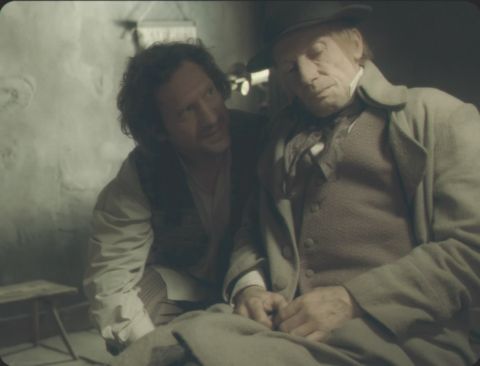
Some centuries ago, Faust (Johannes Zeiler) was a doctor finding life difficult to go on with, and part of that malaise was brought out in his search for the human soul. To further his quest, he would perform autopsies on corpses to see if there was anything inside them besides the guts and entrails every other doctor in his field had discovered, but increasingly he is seeing his experimentation take a turn for the futile, which is even more dispiriting for him. If he cannot find the soul, does that mean it does not exist, or is it simply beyond his abilities to grasp? As his work is amounting to very little, he is becoming destitute, and so must find something to sell to keep himself alive...
Well, there is something he could sell to the moneylender Mauritius Muller in this, yet another version of the Faust legend, as adapted down the years by such highbrow artists as Christopher Marlowe to try and get a handle on just what it is about selling your soul to the Devil which is so compelling a tale. Is it the possibility of gaining your heart's desire upon giving away something with no tangible quality, as simply as applying your signature to a piece of paper, or the implications of what will happen afterwards, when the Devil seeks to claim his prize? In Russian director Alexander Sokurov's hands, what had been in other adaptations a portentous and weighty work had in a strange way more in common with the comedy version from the sixties.
Whether Sokurov was a big fan of Peter Cook and Dudley Moore's Bedazzled went unrecorded, but there was a distinct resemblance to the way his ramble through the yarn unfolded and the way the humourist's playful take on the subject had become such a cult hit for decades. It could be this premise was just very successful when established as a series of sketches a double act could make their way through, as after all a dialogue between the avaricious and needy Faust and the more conniving Devil, the moneylender in this case, was what kept the plot bubbling away, but if this adaptation wasn't anywhere near as funny as Cook and Moore's efforts, it did contain moments which undeniably amused.
Undercutting much in the way of belly laughs was a weird, woozy atmosphere which if you only knew Sokurov from his most famous work Russian Ark because you had been intrigued by the notion of a ninety minute plus movie filmed in a single, unbroken take you would find oddly familiar in the experience of watching his Faust. Much of that was down to this essentially being one long conversation, over two hours of it in this case, with occasional asides which had a tendency to be bizarre, such as when our hero gets his very own homunculus in a jar which must come in handy for those experiments but doesn't impress the woman of your dreams. Yes, it all comes down to love: the middle-aged Faust loves (or lusts after) young Margarete (Isolda Dychauk) but that is not reciprocated.
Which has you wondering if you really want to see this older lech getting his way, and it was true some saw the young woman's portrayal as problematic, not least in the way she ends up as a trophy for the corrupt without much say in the matter personally. Mind you, such was the dreamlike mood to how Faust and Muller wandered through the film that you could be forgiven for allowing it all to wash over you, pausing briefly to note such peculiarities as the Satanic character creating a spring of wine in the wall of a tavern because he was dissatisfied with the booze there. He was played by veteran clown Anton Adasinsky, his impish nature very well served by the script, not to mention selected scenes as where he strips off in a laundry for a bath, revealing his body to be a lumpy, genital-free mass with a little phallic tail at the back. There were serious aspects - Muller contrives to have Faust kill a man, or believe he has to make him more malleable to the soul-selling business - but if this did not connect you would understand why. Also, Iceland's film board were doing well around this time. Music by Andrey Sigle.