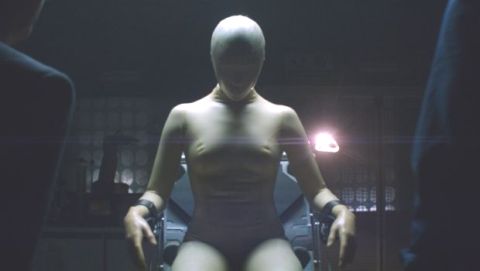
It is the future and another Cold War has developed between the West and the East, with China threatening the Westerners and a covert arms race building between the two sides. The cutting edge of this technology is in robotics, and British scientist, Vincent McCarthy (Toby Stephens) has developed a way to bring seriously brain damaged soldiers back to some sort of life in the hope that they will be able to be redeployed. However, there's a problem in that the subjects have suffered such trauma that when they are revived, they tend to go crazy: Vincent is nearly killed by one of the soldiers who really does murder his colleague. So how do they solve this?
The Machine represented a British science fiction movie for whom ideas were more important than action, although it had both, but was one of those genre efforts where you could very well find yourself ticking off the influences and references if you were of a mind to. That applied to many sci-fi works both big blockbusting and small indie (which this was the latter), so it was what the talent did with the inspirations that mattered, which in this case was to craft a sombre, moody atmosphere which took place largely in the military research base Vincent has a position in, pushing back the boundaries of what was possible. Which you could apply to director Caradog W. James here, as though this was not hugely expensive, he did manage a sleek gloss.
One which belied how much money had been spent on it, thanks to many well-placed and designed computer graphics which brought the fantastical elements to more convincing life. Also brought to life was the movie's android character Ava, played by Caity Lotz who happened to be making waves at the time this was brought to the world in the comic book television series Arrow - in the role of Black Canary - though she doesn't start off as a robot. She actually begins as a promising research scientist, newly graduated and in her way holding as much potential as Vincent did at her age, so how tragic would it be if Ava were stopped dead in her tracks when she finds out... too much?
She was already growing suspicious of the activities in the base, uncovering a conspiracy of sorts where the test subjects may not have given their permission to be used in this manner (bereaved mother Helen Griffin represents all those loved ones left behind by these machinations and demanding answers they are not getting). But the conspiracy goes deeper, with boss Thompson (Denis Lawson) pulling various strings from his office which is, like the rest of the sets, incredibly dark to look at - not morally, but in terms of lighting, so you may well be wondering when someone is going to switch a lamp on so the characters can see properly. Vincent, meanwhile, has his own personal dilemma to occupy his thoughts when his young daughter is struggling with a severe mental impairment.
Obviously he wishes to use his technology for good and bring his daughter back to a normal life, as events conspire to see Ava turned into a robot, bringing questions of how far consciousness can be developed in computers, a very sci-fi idea which courted comparisons to Blade Runner. Though actually The Machine went back further, to Fritz Lang's Metropolis as Robot Ava leads an eventual revolt against the monolithic authorities, and the graceful Lotz used her martial arts training to fine effect. That said, it was her innocence of the android waking up to the pressure of having to kill, in spite of her childlike concepts of right and wrong, which made her the most captivating personality in the plot, both before and after her transformation. There was a hefty amount of ethics to be considered when judging the integrity of the military research going on here, and where the line was crossed from defence to aggression, so food for thought was plentiful though if you wanted a slow-burning science fiction yarn with an explosive climax, that was here too. Vangelis-esque music by Tom Raybould.