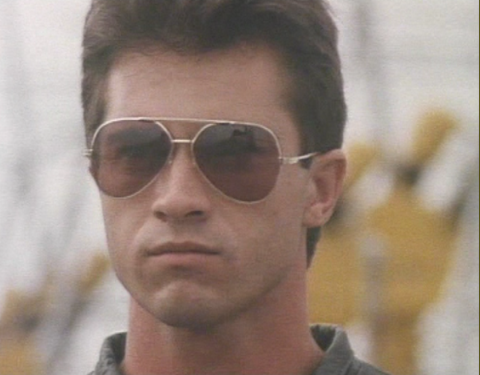
The story so far: our hero Jason Blade (Edward John Stazak) has been through the wringer lately what with his job as a secret police agent in Perth, Australia, bringing him into contact with a deadly organisation trying to overthrow governments and whatnot. The leader was dispatched with by Blade's boss Anderson (John Stanton), or at least left for the cops to pick up, but the man who Blade truly had a grudge against was the powerful Baxter (James Richards), understandable when the villain had killed his girlfriend. After beating him up decisively and sending him to prison, the agent thinks he can settle down with new girlfriend Gemma (Paris Jefferson)...
Some hope of that when the devious Baxter escapes to wreak havoc once again in Strike of the Panther, the sequel to Day of the Panther from which the whole ten minute opening of this movie was edited from, a costcutting exercise when it meant director Brian Trenchard-Smith only had to add about seventy more minutes et voila, a new film was created for your delectation. A lot about this was noticeably cheap, and even more was plainly padding, hanging around until we reached the hand to hand combat sequences which were the mysterious Stazak's forte - nobody seemed very clear on what happened to him after these efforts aside from an even more obscure action flick, Black Neon.
Yes, even more obscure than the Panther series; some report that Stazak became a musician in a wedding band, which sounds like some serious squandering of ass-kicking talents going on right there. These works are not hugely well known which could well explain the leading man's drift into lower key professions afterward rather than finding Hollywood or Hong Kong beckoning, but he could rest assured that once seen, nobody would forget his finest creation, Jason Blade. That was mainly down to the character's aspiring nature, to be an Aussie Bruce Lee of some sort or another, and you could not deny Stazak was a dab hand (or foot) at the art of beating people up martial arts style.
But when most of this series' rivals were at least stretching their funds to one exploding car you could understand why Day and Strike looked rather impoverished as it was mostly the thwack of fist on flesh that they rested on, and the sequel even more so. With a noticeably downsized plot since last time, Baxter (who spends most of his time on the phone) is really the sole bad guy unless you counted his easily bested henchmen, who included a collection of hockey masked ninjas showing up for the grand finale. Before that there were signs of self-awareness in an intermittent sense of humour unlikely to make you laugh thanks to its wit, but possibly because it was so absurd in the context of a so macho it hurts tone otherwise. When Blade goes rescuing in a brothel he meets a man dressed as a chicken, for example.
And another bloke dressed as a schoolboy who wants Blade to hurt him just as he is hurting the security attempting to stop his mission. That said, the most infamous scene sees the man of action proving dancing isn't in his repertoire as he is coaxed into awkward moves by Gemma, who seems to think she's in Flashdance, that before yet another sex scene where you don't see anything important but they endorse Blade's heterosexuality. After a bit of preamble with Gem - Anderson's niece, lest we forget, as it was his daughter who was bumped off - she is promptly kidnapped and held to ransom by Baxter in what looks like an abandoned power station, which handily is reminiscent of the set up Bruce Lee wanted to create for his unfinished Game of Death. This sees Blade overcome the ninja with various weapons such as knives, nunchaku, er, a baseball bat (how come Bruce never thought of that one?) and so forth, as his middle-aged colleague tries to defuse a bomb (cue closeups of a cheap alarm clock) and Anderson supplies psychic guidance. G'bye, Blade!