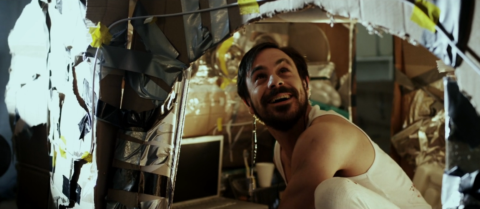
Michael (Emun Elliott) hoped to go to Mars one day, and when his chance finally arrived he applied for the astronaut programme at the European Space Centre in Cologne, Germany, going through a tough training schedule to achieve his goal. Except he didn't. He failed. He wasn't picked and the mission to the red planet went on without him on the exact same day back in Scotland his young son James (Peter Strathern) was trying and failing himself to get on the school football team. But when Michael returned, he decided to go ahead anyway...
Mission was a short film by director Mark Buchanan, who had also concocted the concept screenwriter Gregor Barclay wrote for, and in a cinema landscape where many short films were created simply as dry runs for a version expanded to feature length to show investors what was possible and drum up interest in a ninety minute movie, it was refreshing to watch a genuine brief subject which said all it needed to in twenty minutes or so. Being compact and to the point was an underrated quality, and Mission really felt like a whole entity in itself, part science fiction, part domestic drama about a father's faltering relationship with his son.
We don't get the impression Michael is abusive towards James, not intentionally at any rate, it's just that the disappointment has bred a pathological selfishness in the man where he cannot see anything except his need to succeed in his chosen area of space research. This is where the high concept (for a low budget effort such as this) enters into it as Michael builds himself his own spaceship, not one which works, in a Wallace and Gromit A Grand Day Out style, but one made from scrap and cardboard which has no hope of flying off anywhere, much like its inventor. After giving instructions on how to play mission control to James, he seals himself in and embarks on his journey.
There was a slight J.G. Ballard quality to Mission with its protagonist delving into inner space on the pretense of travelling to outer space, and also the boy fending for himself, though he still attends school where his teacher Mrs Black (Siobhan Redmond) grows suspicious that all is not right at home, which leads to the denouement. Redmond and Elliott were good enough offer their services to this project for free, recognising how accomplished the script was, and if there's a depressive tone to the work which belies a potential for goofiness which went unrealised in this case then it's not so downbeat that it becomes less compelling. There is an irony in the way the plot draws to a close that James seems to have lost his father to his dream, or if that didn't happen before then it has certainly happened now, and would have done whether Michael had been accepted as an astronaut or otherwise, which adds a note of poignancy. If finally this is more worried about James than Michael when both are an equal issue, Mission was well worth your time to appreciate the art of the short form. Music by Barclay and Gavin Thomson.