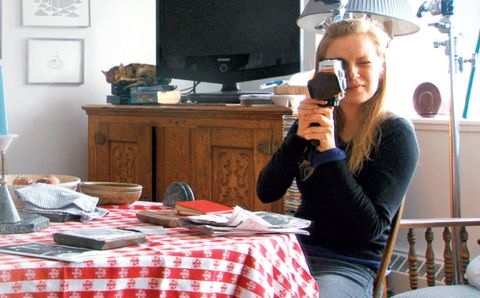
Sarah Polley has assembled a group of people from her family and among friends of that family to discuss her mother for her documentary. Diane Polley died when Sarah was eleven years old, and ever since she has been fascinated by the stories around her, and what fresh light they could shed on how she regarded her and her place in Sarah's life. Her father, Michael Polley, met Diane when they were acting together, and he was of the opinion that she actually fell in love with the roles he played in the theatre rather than the man himself, but then again, maybe she wasn't entirely in love with Michael after all...
The shifting quality of memory was part of what Sarah Polley was wrapped up with in Stories We Tell, and how one person's view of another could differ by quite some degree from a different person's, even though they were discussing the same subject. Although the way it played out in documentary form the results appeared more like she was trying to make sense of a potentially traumatic aspect of her past by using the distancing effect of not only the passage of time, but the factor of the camera lens coming into play. You could attain a certain objectivity by observing even the closest tales to your experience that way.
The main thread was about her mother, and how she was not how she presented herself to her daughter in the brief time they knew each other, although she could withhold information about what had happened to her to even her closest friends. One thing was nagging at Sarah's thoughts, in spite of her spending so much time with Michael as he was basically the one who raised her, and that was the offhand comment which gathered momentum to the point where it preoccupied her and she had to know the truth. Though the truth, as in many twenty-first century films, both fictional and factual, proved a nebulous thing to pin down.
That said, it would be not entirely accurate to say the history unfolding here was as packed full of outrageous twists and turns as such contemporaries as, say, The Imposter or Tabloid, as you more or less have the measure of it by the halfway mark, which sees the director far too reluctant in cinematic terms to let the story go as the film dawdles on that bit too long, especially with a lack of revelation in that final half hour, unless you count the one right before the end credits roll which is amusing in the way it makes Diane seem even more flighty, if that were possible, but doesn't really send it spinning off into a wild new direction, leaving it more of a punchline. As a whole it was a character study of someone who is not around anymore.
Like throwing a pebble into a pond and watching the ripples, Diane's life made waves with everyone she met, she was popular and the life and soul of every party she could attend, whereas Michael was a far less extrovert personality, preferring to stay at home in his own company, which might be the key to why Diane behaved the way she did. Late on it is pointed out that if Michael had been able to love her as much as she loved him then events would have been very different, and ultimately we would not have had this film because we would not have had a Sarah Polley to make it, which must put the director in an interesting position, although apparently the creation of Stories We Tell brought her closer to Michael when it could easily have been the other way around. And yet, she insists on that objectivity, bringing in heavyweight thoughts about how much we have to take for granted about our lives because if we found out about one big lie or one major thing which had been kept from us it would send us reeling, the provocative implication being everyone has this sort of story in them.