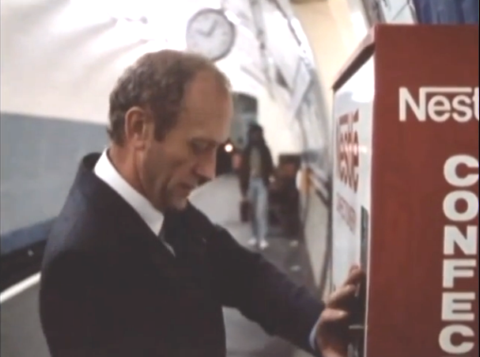
A man (Kenneth Colley) disembarks the train at Waterloo Station and follows the other passengers from the platform, but he seems to have become interested in a young woman (Claire Parker) walking ahead of him, listening to her Walkman. He watches her as she heads for the Underground, close on her heels, noting the busker (Ray Davies) who might know more about his ultimate motive than he wants to be known, and eventually he and the girl reach the platform. She notices him watching her, so he tries to work a vending machine and fails, but still looks suspicious...
Doesn't he know there's been a rapist-murderer in the news whose identikit picture resembles him? Or is he all too aware of that - and if he is, for what reason? There was a load of unanswered questions in Return to Waterloo, as if its writer and director was inviting the viewer to suspect the worst even if they didn't have all the information to make a proper judgement at their disposal. What has made this hour long film a minor cult item was the identity of that creator, we'd already seen him, it was Ray Davies of British rock and pop band The Kinks, here with a different lineup to the sixties version but enjoying a small resurgence in popularity.
They recently had a decent-sized hit in Come Dancing a few months before this was released, and this reworking of material from a then fairly current album may not have included that hit, but did come across as a visualisation of a concept piece. It also, it was difficult to ignore, came across as a grumpy middle-aged man's idea of eighties Britain, with an "O tempora, o mores!" attitude to the youth of the day, most obviously in the roles of the young punks (who were not the punks of the previous decade, but a new breed of Thatcherite upstarts), whose most famous face was Tim Roth, here already perfecting the smarm that saw him through many a villainous part.
Return to Waterloo was a co-production with Channel 4 television, but after they had broadcast it, it received a cinema release as a supporting feature in various places across the world, notably in the United States, then sank without trace, from most memories never mind in actual physical form. For such an ambiguous work, you can see why it might stay with even those less enamoured of The Kinks, as we have to consider whether the traveller - never named - is the dodgy geezer he appears to be, or whether the paranoid attitudes of those around him are influencing us as well. Indeed, everything we see might be in his head as he recalls his life and what may or may not have happened.
Davies was canny enough to cast Colley as the lead, a seasoned character actor who may be held dear by Star Wars fans for his Imperial Officer, but was also one of those British "Hey, it's that guy!" performers who you'd recognise from everything from Shakespeare to Dennis Potter's Pennies from Heaven, not to mention a wealth of supporting roles where he always made an impression. His slightly sinister potential was well used here, as we're not sure if the traveller is someone to be pitied or feared, or maybe both, and the scenes we see of his home life and childhood could be his experiences viewed through the filter of a memory grown jaded with the trials of getting older and finding the world was not as welcoming as he had hoped. But does that mean he doesn't have a job though pretends to, to save face with his wife (Valerie Holliman), or worse, that he is venting his frustrations on his victims, if he has any? You will wait a long time for an answer, some are still waiting, but if the music was lacking the Davies classics, this was an intriguing if vague effort nonetheless.