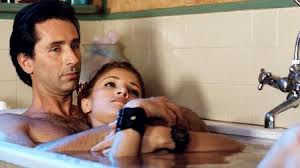
Julien (Thierry Lhermitte), a smug, ruthlessly successful businessman, sees his family off on holiday then spies a pretty girl in a café outside his office. He is soon drawn into a quirky, volatile affair with the capricious Angela (Nadia Farès), which backfires when she suddenly becomes his son’s new nanny. Julien suspects Angela is out to destroy his life. He takes matters into his own hands, but that is only the beginning as events spiral out of control.
Though convoluted at times and a little too reliant upon coincidence, this is a satisfyingly twisted thriller. Christopher Frank teases with a Hitchcockian, 'light' beginning as Julien and Angela's date is interrupted by constant phone calls, but the manner in which he develops his plot via elliptical details is closer to Brian De Palma. It is not what characters see, it is how they interpret what is seen. Frank lacks De Palma's virtuoso camera technique and satirical wit, but makes each plot twist a turn of the screw in a story that springs continuous surprises. Less successful is Jean-Marie Senia's, Pino Donnagio styled score with its screeching strings so overwrought they render several key scenes almost laughable.
The British born Frank worked almost exclusively within the French film industry. He provided the source novel for Andrzej Zulawski's acclaimed L'important c'est D'aimer (1975), collaborated with actor/director Alain Delon on a series of lightweight, but fun action movies in the 1980s, and wrote the dismal Burt Reynolds vehicle Malone (1987). He succumbed to a heart attack in 1993, before the release of this, his strongest film.
Frank's varied career suggests why Love in the Strangest Way wavers from art house psychodrama to glossy, Hollywood style erotic thriller. One could easily imagine Michael Douglas and Anne Archer inhabiting Thierry Lhermitte and Maruschka Detmers' roles. The misleading title suggests a tale of amour fou, but though the film boasts its share of sexy scenes, with Nadia Farès lounging naked for scant reasons beyond viewers' voyeuristic delight, quirky characterizations and some dark humour rank this higher than a soulless skin-flick. Its heart is pure schadenfreude: our pleasure comes from seeing a nasty, self-serving bourgeois type get the comeuppance he richly deserves. Best known for his comedic roles (including Claude Zidi's spectacular Le Ripoux (1985), which mocked exactly the kind of hard boiled thriller Frank used to write), Lhermitte is exceptional as the cocky philanderer whose life unravels spectacularly. Farès is well cast as the alluring, but unhinged femme fatale. Angela goes from psycho to tragic victim to avenging angel, and it's a nicely ambiguous touch that the viewer never quite pins her down, right until the last, stinging twist.