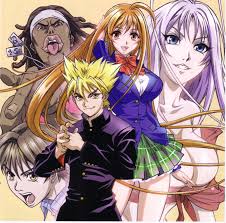
Scrap-happy first year students Souichiro Nagi (voiced by Souichiro Hoshi) and Bob Makihara (Shinichiro Miki) enrol at the famed martial arts high school Todu Academy, expecting to bully all the other kids into submission with their combat skills. Both soon learn the folly of their ways tangling with supernaturally gifted Masataka Takayanagi (Tomokazu Seki) and his all-powerful schoolgirl sensei, deceptively pint-sized purple haired moppet Maya Natsume (Aya Hisakawa). Meanwhile, Maya’s sexy younger sister Aya (Minori Chihara) grows smitten with the hapless Souichiro after he crashes through the ceiling of the girls’ shower room to catch an accidental glimpse of her naked. Under Aya’s benign influence a repentant Souichiro and Bob join Aya’s martial arts group, honing their skills in preparation for epic battles with a sinister conclave of karate kicking teens.
Tenjho Tenge is based on the hit high school martial arts sex comedy manga created and drawn by Oh! Great. Which is likely not his real name. Much like the videogame and subsequent film D.O.A: Dead or Alive (2006), the series drew infamy less for the quality of its action scenes (which are, admittedly, spectacular) than for its gleefully gratuitous nudity and panty shots. It is the sort of anime where agile heroines in short skirts perform extraordinary split-kicks in mid-air just so the boys can cop an eyeful. Aside from going out of its way to fetishize every curvaceous inch of leggy, voluptuous Aya, Tenjho Tenge also employs the outrageous conceit of having her childlike but senior sibling Maya morph in battle into a superhuman samurai sexpot with bosoms that would make the late Russ Meyer sit up and take notice. Sounds puerile? Well, perhaps, on one level it is, but for all the leering cheesecake shots aimed at hormonal adolescents and, let’s face it, dirty old men, this is a disarmingly sweet-natured and endearing anime.
Over the years martial arts anime have scaled the heights of Ranma ½ (1990) and Dragonball (1986) and the tedious lows of Shadow Skill (1996) and (god help us) Tekken (1998). Crucially the successful examples offer something else besides mindless beat ’em up action, whether it is high school romance or celebrating the concept of chivalry. Tenjho Tenge does both. It gently lampoons the manner in which these posturing tough guys are reduced to hapless, slack-jawed buffoons over the mere sight of a hot babe. Equally, the series follows an ethos popularised in Dragonball (though established in earlier manga) of friendships forged in the heat of battle. Adversaries grow to respect one another and build profound relationships whilst honing their fighting techniques.
Hyper-manic as only an anime can be, Tenjho Tenge is no classic but consistently inventive, amusing and, well, fun. What is more, the characters grow increasingly endearing. The plot delves into the psychology of its heroes, exploring what motivates them to become such bad-asses and, most interestingly, what it feels like to lose a fight. This is done with a disarming degree of pathos. There is a poignant scene where Bob laments there are guys out there so ridiculously strong, spirit and guts can’t beat them. At times the series does fall into the same trap as Dragonball Z (1990) of dragging out fight scenes to excessive lengths. What might be exhilarating for fight fans may prove tedious for others, but the central philosophical question (What is strength? What does it mean to become strong?) remains compelling and the plot hints at broader conspiracies to come.