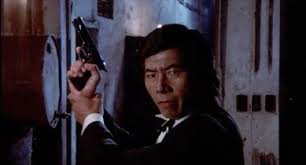
Cheesy synth pop signals we are in Eighties action movie land as dashing DEA agent Shiro Tanaka (Shô Kosugi) startles buff dudes and bikini babes aboard a party yacht when he nabs one of the big players in a drug trafficking ring from Argentina. After a breakneck speedboat chase the guilty man gets a ninja star in the head. Later that night, while Shiro dines with his girlfriend Jennifer (Robin Evans), his partner Ray (Richard Wiley) is tortured and killed by the gang’s crazed numero uno, Havlock (Lewis Van Bergen). A vengeful Shiro goes rogue from the DEA and flies down to Buenos Aires, unwisely bringing Jennifer along on his one-man war against the entire Argentinean underworld. “An oriental just broke through our operation like a tornado”, growls one local crime kingpin. You said it, buddy.
Love him or loathe him, Shô Kosugi achieved something most Asian action stars can only dream of. Which is sustain a career in the mainstream with creative control over his output. Not that this means his films were any good. On the heels of a successful collaboration with director Gordon Hessler with Pray for Death (1985), Kosugi struck back with this far more routine actioner wherein the real-life ninja master once again indulged his James Bond fantasies. Hence, Shô’s crusading cop sports a tuxedo, drives a flash car and wields an array of, frankly low-tech death-dealing gadgets. His superior is also British for some reason even though the accent adopted by the actor who plays him wavers from scene to scene.
Nevertheless, there is little about the plot that is reminiscent of a Bond adventure unless Hessler and co-screenwriters Robert Short and Wallace C. Bennett somehow anticipated Timothy Dalton’s more mundane drug-busting antics in Licence to Kill (1989). This was among a small handful of films scripted by Short who was more active as a visual effects supervisor on the likes of Star Trek: The Motion Picture (1979), Firefox (1982) and more recently, Punisher: War Zone (2008) while Bennett previously devised the story for The Philadelphia Experiment (1984) and penned the horror films The Silent Scream (1978) and Welcome to Arrow Beach (1974), the infamous sole directorial outing for actor Laurence Harvey. Far from spy antics a la 007, their script falls back on ancient cop clichés: the murdered partner, the by-the-book superior, the girlfriend who constantly urges the hero to quit the force.
After spurning the advances of a gagging-for-it Ashley Ferrare in Revenge of the Ninja (1983), this time Shô actually has a proper girlfriend, though quite why he thought it was a good idea to bring Jennifer along on such a dangerous outing proves a mystery. Maybe he’s trying to get her killed. Within minutes of arriving, thugs dangle Jennifer from her hotel balcony and even after she opts to fly home, Havlock’s men seize control of her private jet then give chase through the jungle precipitating the finale showdown. This proved the final film for model-turned-actress Robin Evans, who was also in the fine horror film One Dark Night (1982). Little wonder given she must have been exhausted.
Kosugi mouths the usual clichéd speeches about bureaucratic red tape tying up crime-busting cops but his heavily-accented English leaves him an odd duck in this all-American milieu (“I’ll get that bastard for you, Ray, if it’s the last thing I do!”). His dynamic action choreography yields some exciting set-pieces but in an era when Raiders of the Lost Ark (1981) and Die Hard (1988) were rewriting the rules for action movies, Hessler’s slack staging looks old hat and nowhere as energetic as those martial arts films made in Hong Kong around this time. Almost all Kosugi movies struggle to find opponents able to match him. Rage of Honour is no different with Van Bergen’s mulleted, closet gay, sadomasochistic martial arts madman more campy than menacing. But it is still fun to watch ninja Shô snap necks, slash, kick and punch his way through hordes of hapless henchmen. Even when the villains resort to hiring a couple of sword-wielding ninjas themselves, he makes short work of them. Hessler includes plenty of picturesque scenery and local colour but flat lighting along with Stelvio Cipriani’s Miami Vice-style score imparts a cheesy Eighties TV feel and the make-it-up-as-we go plot is pretty threadbare. By the time things reach the jungle and we are reduced to watching Shô run, climb and jump as he tangles with painted natives the film more or less resembles a videogame.