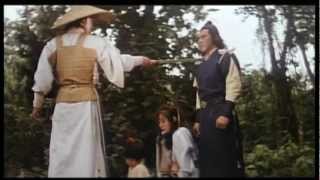
Ignoring all established rules of filmmaking when it comes to establishing time, place and plot, The Master and the Kid cuts to the chase with a crash-zoom onto a room full of dead naked women. Who they were and why they were murdered the film never bothers to explain. All that matters is some prince or chief of some clan or kingdom (again, plot specifics are for wimps!) is royally pissed off and despatches kung fu hero Nan Kung Sao (Yueh Hua) to wreak vengeance on the perpetrators: the nefarious Eagle Clan and their enigmatic leader Ku Yun Fei (Chan Sing). Nan Kung Sao promptly interrogates then kills the assassins uncovering evidence against Ku Yun Fei, but returns home to discover - surprise! - the Eagle Clan staged a pre-emptive strike wiping out his entire family. His little nephew Sao Sun (Man Kong Lung) is the sole survivor. Entrusting the boy to a close friend, Nan Kung Sao sets out for revenge, er, again, only young Sao Sun has no intention of letting his uncle go at it alone. And so, Nan Kung Sao brings the boy along on his revenge rampage, loading him aboard a handy wooden cart.
If this set up sounds at all familiar that is because it was brazenly lifted from the Japanese Lone Wolf and Cub series of films, the most famous of which, Lone Wolf and Cub: Baby Cart at the River Styx (1972) was released internationally as the bizarre patchwork job Shogun Assassin (1980). Stealing plot-lines and ideas from foreign films has long been an accepted practice in Hong Kong cinema going back to the days when Shaw Brothers routinely remade Japanese musicals and melodramas. In the arena of martial arts films, Jimmy Wang Yu more or less remade Akira Kurosawa’s seminal Seven Samurai (1954) as his highly accomplished Beach of the War Gods (1973), only substituting the septet of roving ronin with his lone self against an army, ’cos Jimmy is just that tough, y’all. Certainly the most shameless co-opting of Japanese source material were the handful of bogus Zatoichi films cranked out with a Shintarô Katsu impersonator (yes, there was such a thing) named Sing Lung.
As rip-offs go, The Master of the Kid is solid chop-socky fare provided viewers are willing to overlook some zoom-happy camerawork and frankly whiplash-inducing editing, yet lacks the distinctive gothic grand guignol edge of its inspiration. It also fails to pack the same emotional punch as a result of the filmmakers curious decision to recast young Sao Sun as the hero’s nephew rather than his son. Nevertheless the film does hit on some of the same themes present in the original scripts by famed manga auteur Kazuo Koike. Nan Kung Sao’s quest for revenge pits him against surprisingly sympathetic opponents, often ordinary decent folk driven to kill because they have no other means to earn their way out of poverty. An early scene has the hero despatch a snivelling minion in front of the man’s wife played by sexploitation regular Hu Chin (who that same year starred opposite Yueh Hua in the saucy ghost story, er, The Ghost Story (1978)) who insists he is not a bad man, only driven to commit murder to support his family.
The bulk of the plot concerns Nan Kung Sao’s battle against Pio Lung, a young man with exploding balls, um, I mean spherical silver explosives. Nice guy Pio Lung wants to collect the bounty on Nan Kung Sao’s head so he can support his starving girlfriend, Piu Tusan (Pan Ying-Tzu, star of the seminal swordplay film One-Armed Swordsman (1967)). Complications arise when Tusan befriends Sao Sun, saving his life from a snake, and the lovers start having second thoughts about going after his uncle. The knock-on effect is that the supporting characters prove rather more sympathetic and compelling than ostensible hero Nan Kung Sao who actually goes AWOL for long stretches of plot. The usually engaging Yueh Hua is stoically one-note and while youngster Man Kong Lung is a decent child actor, the film does not seem to know what to do with his character. Lam Fook-Dei is more than capable when it comes to staging an arresting action scene but fumbles his storytelling. The plot proves repetitive and heavy-handed when it comes to ladling on tragedy even after characters learn their lessons, culminating in the offscreen but still unnecessary rape of one heroine who then dies pointlessly and rather abruptly during the finale. Kung fu soundtrack connoisseurs should listen out for music “borrowed” from the climactic Death Star battle in Star Wars (1977), Ennio Morricone’s main theme from Once Upon a Time in the West (1968), vintage Jean-Michel Jarre tracks and, remarkably, the theme from daytime soap opera Days of Our Lives. It also features a memorably syrupy Mandarin ballad (“a manly man should not shed tears!”).
Not a top-flight kung fu film then, but worth watching for some choice lines (“Beware of his thunder balls, they are so explosive!”) and a priceless scene where Nan Kung Sao battles the Eagle Clan’s swooping mascot and with a swipe of his sword (and a judicious jump cut) turns it into a supermarket frozen chicken. That’s some pretty good kung fu, there.