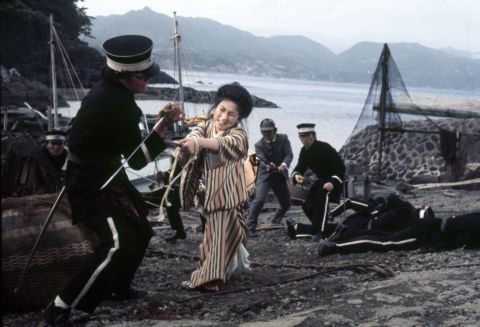
Yuki Kashima (Meiko Kaji), known as Lady Snowblood, is still on the loose after her killing spree of vengeance against those who wronged her and her mother, but now she has satisfied that thirst for revenge she has to live with her reputation as one of the most prolific female murderers in Japan. This also means she is under attack almost every day by those who would wish to arrest her, or even execute her, ambushes she fends off with her uncommon skill with a sword, though one day, after catching her foot in a mantrap, she decides she has had enough and allows herself to be captured...
Lady Snowblood, both films, will forever be mentioned in the same breath as Quentin Tarantino's Kill Bill movies since he was so inspired by them, or at least happy to recreate much of this source's style, plot and the badass heroine out for revenge. But this second entry saw her getting over what drove her before, and in the first ten minutes it's as if she is winding down from the flurry of the previous outing, eventually going quietly with the authorities instead of massacring them as she has done before - although even so, she slashes a few of them with her blade before the equivalent of saying "It's a fair cop, guv, you've got me bang to rights."
In spite of her being sentenced to death, and her acquiescing to that judgement, life isn't finished with Yuki, so on the way by horsedrawn carriage to her place of execution she is waylaid by a gang of masked tough guys who kill off the guards and commandeer the carriage, taking her to the hideaway of some government men, led by Seishiro Kikui (Shin Kishida), who want her to put her skills to good use. Here is where we get a history lesson about the Russo-Japanese war of the early Twentieth Century, which the Japanese won, and that brings us to the political rebels who wanted to do something about the repressive rulers, so what Yuki has to do is take one of these insurgents out.
Now, they cannot simply walk up to him in the street and shoot him, although considering all the other things people get up to here you do wonder why they don't do precisely that because it would save them a lot of bother, so Yuki has to pose as the man's housemaid. The target is Ransui Tokunaga (Jûzô Itami), described as an anarchist though we might describe him as a leftist, who actually has some reasonable things to say about the state of his nation and how it could be made fairer. He also has a foot fetish judging by the sex scene we see plonked down out of the blue, apparently because director Toshiya Fujita felt it was necessary to keep the audience's prurient interest going.
So you had a curious mixture, not a unique one by any means, of exploitation elements to the fore yet jostling with position with the social commentary, which was not something the first part of the two-film series had done much, but Fujita had wanted to expand his viewers' horizons this time around. However, what really captures the attention, as was the case with many of her other films, was Meiko Kaji, one of the first woman action stars to rival the men in illustrating an "anything you can do" sensibility to thrillers and martial arts movies. This earned her a worldwide cult following which endures to this day, and her stoicism here (she never cracks a smile, not once) spoke to a soul-deep angst and nobility under the enormous pressure of the burden of her violent existence. It's not only Yuki being violent, there was plenty of bloodletting, and if there was a sense of that bit too much on its plate this time around in comparison with the purity of her mission before, she remained the best reason to keep watching. Music by Kenjiro Hirose.




 Display comments