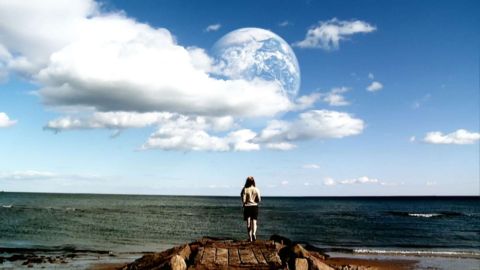
When Rhoda Williams (Brit Marling) was seventeen she received news she had been accepted to MIT, which she was delighted about and enjoyed a party to celebrate, but that night, driving home, she heard on the radio that there was a fascinating astronomical phenomenon discovered: a new planet in the Solar System. Not thinking straight, she stared out of the side window to see if she could spot the heavenly body, which was the biggest mistake of her life as she promptly crashed into a car stopped at the traffic lights, killing a woman and her small son, and leaving the husband (William Mapother) bereaved...
The idea of a mirror version of Planet Earth had been used before, in the Gerry Anderson would-be sci-fi blockbuster Journey to the Far Side of the Sun, but that was more a space adventure inflected with the cosmic possibilities of mankind's position in the universe, whereas Another Earth was more of a drama inflected with the science fiction. Not that the fantastical elements were extraneous to the lead characters' heartache, as they were actually instrumental in keeping the plot moving along as we jump forward four years to see Rhoda released from prison, and the planet is now a fixture in the sky (along with its moon).
This means the possibility of contact with it is increased, and as it looks just like our world from afar the questions of how similar it is on the surface are prominent in everyone's minds. Meanwhile, Rhoda is still intrigued - a brief intro describes her interest as a child in astronomy, but more pressing concerns are troubling her, such as her crushing guilt and her blown chances of making anything of her life now she has a criminal record. She takes a job as a cleaner at the local school, a real comedown from where she could have been if she hadn't been so foolish that night four years ago, yet for her own peace of mind feels she must make amends somehow.
But what to do? How about track down the bereaved husband, John Burroughs? Mapother would be best known as the intimidating Ethan on television serial Lost (or as Tom Cruise's cousin), but here he had a character more recognisable as a three-dimensional person, which he handled with professionalism. Marling did well with her role too, but then she had co-written the script with director Mike Cahill so you would have expected her to have a fair idea of how to portray it to its best advantage, though at the time unfortunate scheduling saw Another Earth compared with Lars von Trier's Melancholia since they both contained rogue planets in the vicinity of our own.
Yet Cahill and Marling took a different approach, as where Melancholia and its globe were representations of the protagonist's hatred, in this case the other world had more to say about fate, for once contact is made it is found that there appear to be precisely the same occurences and population there that we have here. Rhoda cannot help but wonder if her equivalent up there has suffered the same misfortune she has, and more importantly if there's a way she can sort herself out if she manages to find out through a chance derived from the lottery to see who is allowed to take a spaceship to see what the other world is like. In the meantime, she poses as John's cleaner, growing closer and hoping she will be able to, er, come clean soon. For all the epic qualities of the drama, Another Earth was very low key and intimate: take away the sci-fi and it would be curiously slight, in spite of the tragic aspects, so most of it cast a muted spell which unfortunately showed up its conceits as you had more space to consider its absurdities. Music by Fall On Your Sword.