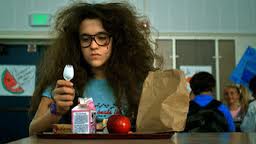
Frizzy haired fourteen year old orphaned high school misfit Spork (Savannah Stehlin) endures an unfortunate nickname on account of being born a hermaphrodite. Needless to say, her uniqueness leaves her the butt of much mockery, not least from aptly-named Betsy Byotch (Rachel G. Fox) who rules the school with her posse of bouffant blonde sycophants. Sad, lonely, soft-spoken but desperate to fit in, Spork has one friend in sassy trailer park neighbour Tootsie Roll (Sydney Park). When Tootsie Roll sprains an ankle rehearsing a dance routine, Spork sets out to win the upcoming Dance-Off. It is not simply a chance to shine in front of the whole school, including mean Betsy. Spork aims to win a cash prize so she can help Tootsie Roll visit her father in prison. There is just one problem. Spork can’t dance.
If John Waters made High School Musical (2005) it might have turned out something like Spork. With day-glo décor, confrontational social satire, taboo-busting attitude and jarring yet accurately profane teen dialogue spouted by a cast of colourful oddballs, this tips its hat towards Waters’ oeuvre. Yet under the deceptively abrasive surface lurks a big gooey sweet heart not too different from Disney fare. It is interesting how individuality has become the defining theme of the resurgent musical comedy genre, though not that surprising given it is widely embraced by the gay community. Billing itself as a film about “standing out and fitting in”, Spork shares an ethos in common with television phenomenon Glee though both are arguably indebted to the more obscure but influential indie film Camp (2003).
Actor-turned-indie auteur J.B. Guhman Jr. weaves a heartening message about nonconformity as the film sagely observes that high school is where we begin to discover who we are. Spork’s personal problems are simply an extreme version of the sort of identity issues plaguing millions of kids around the world. Our heroine eventually discovers she is not the only awkward misfit at school, finding a kindred spirit in Charlie (Michael William Arnold) who has two gay dads but is quick to assert he is not gay, despite his flamboyant manner and bedroom full of male pin-ups. In fact, Charlie becomes Spork’s love interest as the pair bond over their mutual affection for The Wizard of Oz. Amusingly, Spork grew up adoring The Wiz (1978) and is flabbergasted to learn there is another “white” version.
Tonally similar to Napoleon Dynamite (2004), another quirky comedy about a frizzy haired high school misfit, the film bears the same panoramic, observational style akin to a live action Peanuts with a surrealistic streak and is set in a non-specific time period cross-blending pop culture from the Eighties, early Nineties and turn-of-the-millennium. It meanders in parts with some extraneous characters and wilful eccentricity that may grate on mainstream sensibilities, yet has real heart and soul. The film was criticised in some quarters for its portrayal of trailer park environment which admittedly skirts caricature, though that is a given with comedy. It is actually fairly affectionate in its attitude towards blue collar family life while acknowledging the harsher aspects that its protagonists long to escape.
Newcomer Savannah Stehlin gives an instantly engaging, sweet and vulnerable performance. For all the film’s cartoonish exaggeration it is an honest portrayal of high school, seguing from Darwinian social embarrassment to transcendent moments of pure adolescent joy. Guhman stages some dynamic musical sequences with bravura editing by Philip Bartell while D.P. Bradley Stonesifer pulls off an array of beguiling, ingenious lighting tricks. There does seem to be a trend of late in indie comedies to climax with a cathartic dance contest. While the feel-good finale plays to the formula it is no less heartening plus the soundtrack, by Casey James and the Staypuft Kid, mixing vintage hip hop with sounds reminiscent of Nineties console games, is similarly infectious.