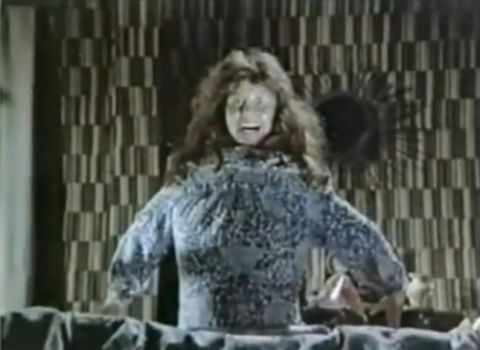
An Islamic scholar is wandering around this desert region in the Middle East for research purposes when the excavation occuring there unearths an amulet which appears to have great significance, a supposition underlined by the large statue found nearby which likewise indicates some ancient demon had been paid tribute to many centuries ago. Meanwhile, in Istanbul, the little girl Gul (Canan Perver) stays with her mother (Meral Taygun) since her father is no longer around, but she has made the mistake of playing with a ouija board: where could that lead?
If you've seen a certain blockbuster released the year before this one, you may have more than an inkling as to the answer to that question, because Seytan was one of those Turkish movies which gleefully raided the archives for a hit they could copy, in this case The Exorcist. They didn't have much of a search to settle on that moneyspinner turned cultural phenomenon, as there were quite a number of other territories churning out their facsimiles as well, but while the Italians, for example, managed to gain a following thanks to their intepretations, the Turks were simply heaped with derision instead. Was that fair?
Yes, yes it was, because while they could have conjured up something inspired by the William Friedkin movie with a Turkish twist, all they did to the William Peter Blatty script was replace the Bible with the Qu'oran, Christ with Allah and have Zam Zam water rather than holy water splashed about, otherwise what you were watching was low budget and alternative language scene for scene business. Some of this was more surprising than others: sure, you had the girl turning her head around alarmingly, but only 180 degrees, not the full 360, yet unexpectedly she did bloodily masturbate with a crucifix (er, letter opener) as well, which you might not have expected from the society Turkey was in the seventies.
But rather than an attempt to be controversial, the stronger sequences were here simply because they were in the original, there wasn't any purpose to them other than that. Naturally, while it was possible to take the American movie seriously, you would have a lot more trouble doing the same with this, which was patently crafted in the hope that the audience had not seen the 1973 film and therefore didn't have the frame of reference to compare. On the other hand, it was such a famous work they were remaking that even if you hadn't seen the source you would be well aware that what you were seeing was second best, if that, which would give rise to the most obvious reaction.
Which was laughter, naturally, as director Metin Erksan did not have access to the same resources as Friedkin had, rendering his shocks rather daft. Some would say the original was rather daft too, but you couldn't disagree that it had a serious intent and theological message to impart, whereas in this it was simply the Great God Mammon who was calling the shots: that was make as much profit as possible before the audience began wondering why they were not watching the proper version. Various aspects of the classic horror were plonked down without so much thought, so every five minutes you'd get a couple of minutes of Tubular Bells played just because it was the tune most associated with the first one, and the girl had been cast thanks to her resemblance to Linda Blair, dubbed with a deep voice once she had been possessed which was unintentionally amusing here. That was nothing compared to the restagings later on, guaranteeing hilarity as the story trudged to its conclusion.