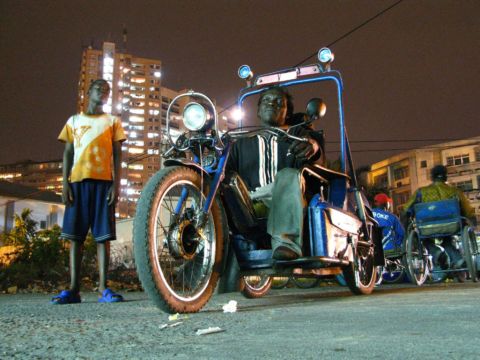
In 2004, a couple of French documentary makers, Renaud Barret and Florent de la Tullaye, became interested in a group of musicians from the Congolese streets of Kinshasa who were overcoming terrible odds to play their music, not least the fact that thanks to polio they were all disabled and unable to walk without crutches. They solved that by using a type of wheelchair crossed with a tricycle, and the help of those willing to push them along in their transport, but they were nevertheless forced to live in shelter when they weren't scraping by begging...
Benda Bilili! was a documentary that bore obvious comparisons to that nineties music documentary hit The Buena Vista Social Club, except if anything the subjects were more blatantly inviting pity in their impoverished circumstances. It was thanks to sympathetic direction that we never started to think the band were utterly pathetic creatures, partly thanks to the terrific music which they managed to create on often handmade instruments, but also because we were able to immerse ourselves in their world to an extent that while we may not be able to relate completely, we did get a throrough idea of what they were like as people.
As opposed to some social problem who otherwise would not get international recognition unless they were appearing, staring plaintively out of publicity for a charity drive. They were well aware their lives were amongst the least well off in the world, and didn't need us to remind them of it, so what the band did was see a way to improve their lot and grab it with both hands. Although the rather rough assembly of scenes could make this hard to follow in places, you were given enough information to know that they were not a bunch of self-pitying losers, but people with a sense of humour, talent, and ambition against what by too many rights should have been lives of misery.
Certainly there was hardship here that the camera captured, as at one point the shelter the band stay at burns down and they lose just about everything, yet the attitude is not one of dwelling on the incident, it's more "OK, that happened, what do we do next?" When Barret and de la Tullaye began their film, they had no idea they were going to spend over five years on and off with these people, but that was the amount of time it took for the band to actually record their album at a local studio thanks to various setbacks. Along the way they picked up another member, the young boy Roger, who makes credible, melodic sounds with a tin tied to a piece of wire, serving as the epitome of their can-do endeavours.
We only really get to know Roger and Leon, the leader, in any great detail, but the others fill out a colourful cast of characters who never doubt they can succeed, which makes it all the more anxiety-inducing when the years go by and they don't appear to be any closer to their goal. In the meantime we see the conditions of the rundown Congolese capital, with brief mentions of the political corruption and religion's hold over the nation, sketchy yes, but enough to offer a flavour of what day to day life is like: the scene where street kids throw themselves in front of cars out of desperate hope for handouts speaks volumes. Crime is always a factor as well, as it's clear Staff Benda Bilili are genuinely heroic in their scheme; it's no spoiler that they do reach their promised land of a European tour, a truly inspiring moment that may represent all sorts of rags to riches clichés yet remains cheering because it was real. Not only did they record that album, they made a second once the film was over.