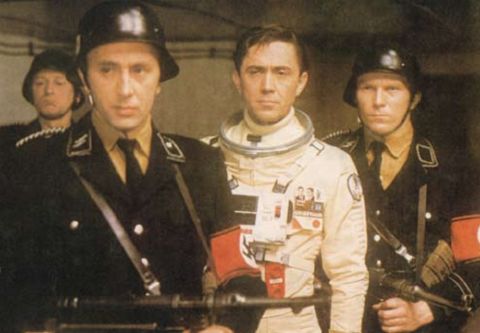
It is the near future, and a group of original Nazis from the Second World War are not willing to give in just yet. With the help of anti-ageing pills they have been well-preserved since they lost the battles in 1945, and now their patience has been rewarded that time travel has been invented. But it has not been put to any pioneering use, it's simply implemented to boost the tourist industry: holidaymakers can go back to witness famous events or even see what the dinosaurs were like in the flesh. The Nazis, however, want to return to 1944 and meet Adolf Hitler, for they have a present for him...
Science fiction was a surprisingly popular genre behind the Cold War's Iron Curtain, and many Soviet Bloc states saw their film industries investigating the possibilities of fantastical plotlines, either as serious examinations of society through the lens of the genre, or as a more humorous entertainment - though still with that serious undercurrent of taking a long look at what ideology could be employed in creating their societies. That was not to say this little Czechoslovakian item was weighed down with the issues facing your average Communist-era Eastern European, as its feet barely touched the ground.
That was thanks to an ingenious storyline which didn't merely use the time travel device for buffoonery, it tried to tie the audience's attention spans in knots as they attempted to fathom what exactly was going on and how all this increasingly unruly narrative was going to resolve itself. Rest assured, it did make sense by the end, but even so if you thought about it too hard you might break the spell when something arose in your mind that didn't entirely add up. Such is the way with many a time travel movie, though director Jindrich Polák took his time in getting to the crux of the conundrums.
We start off with twins, Jan and Karel (both played by Petr Koska) who live together in the same apartment. But what scientist Jan doesn't know is that Karel has been up to no good, he's actually a fascist hired to be the pilot for the Nazis' jaunt back to the Second World War. Unfortunately for his cohorts, there's a snag - there are quite a few snags mounting up, as it turns out - when Karel chokes to death on a breakfast roll on the morning of the launch, leaving Jan to pretend to be him so as not to send Karel's fiancée suicidal. As you can see, from the opening quarter hour this is already growing fiendishly complicated, and that's without even getting into the paradoxes.
Anyway, Jan continues his subterfuge because as the scientist who worked on the time travel programme he knows how to fly the rockets, which work by leaving the Earth's atmosphere, doing their timey-wimey thing then returning at the appropriate point. With the Nazis aboard, they soon force the mission to... not 1944, actually winter 1941 where their gift of a nuclear weapon is less appropriate. A nice touch here is that nobody in the past, present or future believes a word of the travellers' claims, because if someone told you they were from the future, you wouldn't, would you? So the Nazis' scheme goes to pot as everyone, including the stewardess and two American tourists who accidentally went with them, ends up locked in the jail cells of Hitler's bunker. There's more to come, involving Jan saving the lives of people in his present and finally working out happiness for everyone, an optimistic note for a comedy that may not be hilarious, but delivered on its mindbending premise. Music by Karel Svoboda.