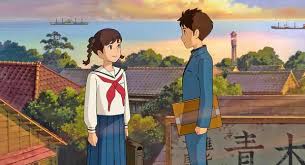
Set in Yokohama in 1963, one year before the Tokyo Olympics, From Up On Poppy Hill concerns Umi Matsuzaki (voiced by Masami Nagasawa), a caring and conscientious teenager growing up amongst a close-knit family of five. Each morning she hoists a pair of signal flags atop her seaside house in Yokohama Bay, in honour of her late father whose ship went missing in action during the Korean War. At school, Umi finds herself embroiled in a heated campaign to prevent the demolition of an old clubhouse, led by handsome, rabble-rousing newspaper club president Shun Kazama (Junichi Okada). Growing closer, the pair seem on the brink of falling in love until Shun makes an unfortunate discovery that leads him to drastically reassess their relationship.
Japanese animation has a reputation for outlandish science fiction and fantasy stories but quite often handles slice-of-life dramas with a skill and sensitivity worthy of the best live action art-house movies. Upholding this tradition, Goro Miyazaki takes the helm for his second film for Studio Ghibli after the much-maligned Tales from Earthsea (2006), which earned him the ignominious honour of Japan’s equivalent of a Razzie award as worst director. Happily, From Up On Poppy Hill marks a significant improvement on his first feature, although not without its problems. For long time Ghibli fans, it is tempting to ascribe many of its finer qualities to the creative contribution of Goro’s famous father, Hayao Miyazaki who serves as storyboard artist and co-screenwriter. Especially given the plot reflects the elder Miyazaki’s impassioned political beliefs, his fondness for diligent, idealistic young heroes and keen insight into the psychology of young people laced with a generosity of spirit and wry humour.
Events unfold amidst the run-up to the Tokyo Olympics, a time of student rioting and tumultuous civil unrest throughout Japan. The film reflects some of this, albeit in its own genteel fashion. Aside from adopting Kyu Sakamoto’s J-pop classic “I Will Walk with My Head Up” (a.k.a. “Sukiyaki”, the first Japanese song to top the American pop charts), the film forgoes nostalgia for the most part and instead draws allegorical parallels between the activities of the school kids and the generation that went on to tidy and restore Japan as a whole. The clubhouse becomes a haven of youthful idealism and forward thinking, preserving the best of the old but with a progressive attitude. Admittedly the underlining political message is somewhat nebulous. Studio Ghibli mounted similar socio-realist allegories in Only Yesterday (1991) and Whisper of the Heart (1995) but while those were thematically ambitious pictures, by contrast From Up On Poppy Hill is rather slight.
What good qualities the film does possess are almost undone by the prosaic presentation. Goro Miyazaki does not embrace the possibilities of his chosen medium. The film boasts beautiful production design yet strangely static animation. It could almost be a live action made-for-TV movie. A poignant dream sequence wherein Umi imagines both her parents are home and well again ranks among several set-pieces that are so low-key as to come across simply vague. Which is not to say the film lacks charm. Shun and Umi are sweet, engaging characters and the events at the school clubhouse prove genuinely uplifting. While it would not be fair to spoil this film’s sole major twist, it is worth mentioning that the resulting aftermath is well observed. Shun subtly distances himself from poor, confused Umi then eventually suggests it is better they set aside whatever feelings are blossoming between them and settle for being friends. The plot quite literally races towards a hastily contrived finale but if, like me, you’re a sucker for young love, it will still likely leave a smile on your face.