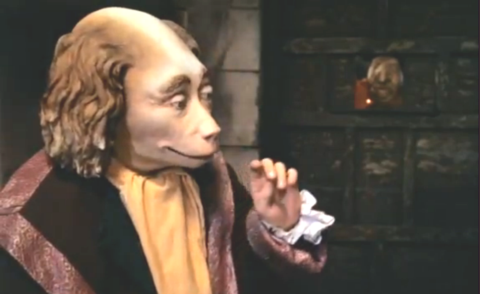
The Marquis de Sade (voiced by François Marthouret, performed by Philippe Bizot) is stuck inside the Bastille prison on account of his excessive behaviour, including writing obscenities and blasphemies. His gaoler is Ambert (Michelle Robin and Gabrielle van Damme), who knowing of the prisoner's reputation, dreams of the day he will finally agree to sodomise him, though as yet the Marquis has all too eagerly resisted, leaving the convict mostly alone with his thoughts, which he sets down in writing, and his enormous penis, which carries out conversations with him...
As you can guess from that introduction, this was no ordinary historical document, and was more of a strange experiment in boundary-pushing, or so it would seem if it had come across as if the filmmakers believed they were doing anything any more bizarre than having the story of de Sade's later years told through the medium of actors dressed up as human-animal hybrids, complete with rubber masks none too well animated to create the illusion of speech (obviously the actors dubbing the action helped in that respect as well). The results were one of a kind, though there could have been a good reason for that.
The closest in cult film terms would be Peter Jackson's emetic puppet movie Meet the Feebles, yet Marquis, for all its bad taste, appeared to be under the impression it was actually very classy, taking subject matter from revered history - the events just as the French Revolution was about to begin - and giving it a fresh spin as if it were a period drama from whatever era you chose. This was no Cyrano de Bergerac or Manon des Sources, however, because neither of those featured the Marquis de Sade having conversations with his member, which has a little talking face on it and must be continually pushed back into his trousers when anyone else arrives to talk to him.
How this film was able to be made gave rise to all sorts of questions, as you can't imagine writers Roland Topor and Henri Xhonneux (who would both be dead within a few short years) attending a meeting with the money men and saying, "Sure, then there's a scene where a pregnant cowgirl is chained up and milked - oh, not a cowgirl from the Wild West, but an actual half cow/half girl, and then - " and receiving anything but looks of bafflement. To its credit, they saw through their ideas with remarkable dedication, yet whether it was any use as a historical document was highly debatable, with details such as the Marquis living in a dank, stone cell (he had carpets and curtains in real life) mixing with fanciful extremes of weirdness.
Those included animated sequences where we were privy to de Sade's dream life, but as this was presented made about as much sense as when he was meant to be awake. Some saw this as a comedy, and there were indisputably farcical situations contained herein, such as the subplot where de Sade is bribed for his freedom by insurgents in the next cell if he agrees to bugger Ambert. In fact, there were a lot of buggery references in this, presumably as a joke, though it was difficult to tell one way or the other, but what you could see was the curiously sombre tone to the proceedings, staying deadpan to confuse the unwary, but as a result confounding the entertainment factor beyond the consistent levels of peculiarity. Topor was well known in France and Belgium for his offbeat output - cartoons were his most successful metier - and he and Xhonneux had collaborated on a children's puppet show before, making this something like Jim Henson packing The Dark Crystal with X-rated depravity. Music by Reinhardt Wagner.