In feudal Korea, the people are oppressed by the might of the King (Pak Yong-hok) who leaves them starving, tortures them and takes away their menfolk to forcibly recruit them into his army. In one village, blacksmith Takse (Ri Gwon) dutifully works for the betterment of the locals and his son and daughter, but one day he notices Inde (Sop Ham Gi), the suitor of his daughter Ami (Son Hui Chang) has been stashing weaponry so that he can join the revolution. Unfortunately, the King's men find out about this uprising and do their best to quell it - is there no one who can help the peasants?
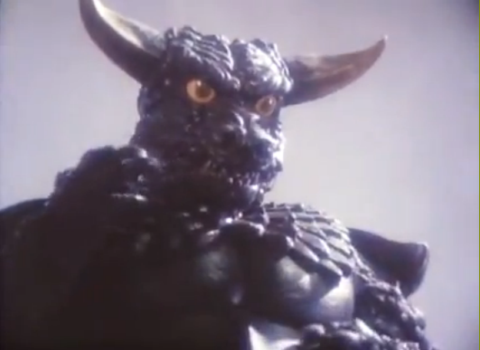
How about a man in a rubber suit? No, not the Gimp from Pulp Fiction, a proper giant monster in this, the one film from North Korea which people might actually have heard of. That was because its producer was Kim Jong-Il, the world famous dictator who happened to be a major movie buff and saw to it a number of films were made in his homeland, all naturally conforming to state restrictions. In this case he was a big fan of South Korean director Shin Sang-ok, so instead of inviting him over to craft an epic he went to extremes and, as Shin told it, had him kidnapped along with his wife and transported north of the border, then set to work on a movie Kim believed would be a masterpiece.
Quite if you have to take this with a pinch of salt or not is not entirely clear, but it was true Shin made the film (and it's not even certain he completed it) then got the hell out of the North as soon as he could, so what he thought of his efforts in creating a totalitarian Godzilla movie was for him to know, but the results naturally generated a small following abroad of curiosity seekers. For one of the most secretive countries on the planet you had to be intrigued about what passed for entertainment there, though as a Japanese firm were brought in to achieve the special effects you might wonder exactly how secretive they actually were, though there was a lot that threw up questions when it came to Pulgasari.
Such as, did nobody see the irony in a crazed with power dictator punishing his citizens making a movie where just such a dictator was the main antagonist? When the King begins his weapons programme to build missiles which will have a devastating effect, you might well be thinking over the parallels the storyline had to real life, though those associations would be more tenuous when it came to regarding the giant monster itself. Not that it starts out as a giant monster, it actually begins life as a tiny doll made of rice by the imprisoned Takse who expires soon after, and we are presumably intended to see the blue glow that appears around the figure as his spirit entering the future creature.
Just add blood from Ami pricking her finger on a sewing needle and Pulgasari as they call it (ad nauseam, often at the top of their voices) springs to life and commences its habit of eating iron, it can't get enough of the stuff. Soon the little guy is getting bigger, resembling Godzilla's little boy and supposed to be cute, but my they grow up so fast and before long it's towering above the peasants who find its invincibility handy when battling the King's forces. Realising he has met his match, His Majesty hatches a plan to melt Pulgasari in a huge fire, which does nothing but heat it up leading to a startling scene where it knocks the soldiers out of their boats and boils them alive by immersing itself in the river. As with much propaganda, the powers that be don't like to depict themselves in their fiction as all conquering at the outset, so the heroes have to be the underdog at first, and so it was here. Some see the giant creature as a metaphor of capitalism, but it could just as easily be the might of the Communist revolution, whichever, it was stodgy stuff.




 Display comments