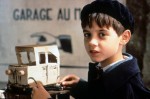
Jacquot Demy (Philippe Maron) is a little boy growing up in the French town of Nantes towards the late Thirties. His father (Daniel Dublet) runs a garage while his doting mother (Brigitte De Villepoix) is a hairdresser. The family live happily and enjoy singing and going to the movies which fire young Jacquot’s imagination. Growing up amidst the outbreak of the Second World War and the Nazi occupation of France, he develops a fascination with all forms of performing arts, not just the cinema but theatre and puppet shows too. As time passes, a maturing Jacquot buys a second-hand 8mm camera and starts making his own movies using cut-out animation.
Throughout the past twenty years renowned filmmaker Agnès Varda made several projects paying tribute to her husband, Nouvelle Vague legend Jacques Demy who succumbed to AIDS in 1991. None more poignant than Jacquot de Nantes, a docudrama drawn from Demy’s own autobiographical journals that was filmed as the great director himself lay literally on his deathbed. It opens with a shot of Demy himself relaxing on the beach at sunset, sifting grains of sand that slip gently through his fingers as if stating plainly that his life is ebbing away. Demy reappears on camera periodically throughout the film, offering his personal reminisces but for the most part Varda stages recreations of his childhood in nostalgic black and white. Now and then the screen erupts in vibrant colour whenever little Jacquot watches a theatrical performance or meets someone that has a profound effect upon his life, as with the lovely girl next door (Hélène Pors) who becomes his first childhood crush.
Instead of a straightforward biography, Varda attempts to portray the evolution of Demy’s artistic sensibility from childhood beyond adolescence. “Jacques’ childhood was his treasure and the source of inspiration for his films”, she remarks at an early stage. To underline this point Varda follows significant episodes in Demy’s life with clips from his movies. So a bravura tracking shot of Jacquot playing in his father’s garage then cuts to Nino Castelnuovo singing in his garage from the sublime The Umbrellas of Cherbourg (1964). A visit from a glamorous aunt is followed by a sequence from Lola (1961) with sexy Anouk Aimée. Jacquot’s mother singing while she cooks anticipates a clip of Catherine Deneuve doing the same in Peau D’Ane (1970).
Although the continuous clips from Demy movies are a welcome sight for fans, in particular glimpses of obscurities like The Pied Piper (1972), Parking (1985) and Une chambre en ville (1982), the device grows rather repetitive and unintentionally distances us from the story. In fact the most part it might be fair to say that Varda’s detached style invites viewers to observe events rather than grow emotionally involved, despite wholly engaging performances from the entire cast, especially the young trio assembled to portray Demy at various stages in life. Nevertheless, Varda’s vibrant editing and masterful use of colour poetically stress the power of art to inspire and enlighten, as well as the subject’s lifelong devotion to music and beauty. The pervading tone is one of buoyant though low-key charm, offset by the occasional sober note as when Jacquot stumbles upon a murdered woman or the bombing raid that claims several lives around Nantes and instils his lifelong aversion to violence. The film fittingly devotes a great deal of time to detailing Jacquot’s painstaking attempts at mastering the technical aspects of filmmaking and does a fine job capturing the triumphs and setbacks that led to the rise of a great artist.