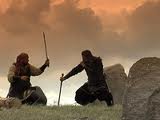
An encounter between an ancient druid and a seemingly significant little girl amidst a circle of stones proves an awkward framing device for this ambitious but unwieldy low-budget Italian epic. From this the narrative segues to the eve of the Battle of Hastings in 1066 where William, Duke of Normandy (Maurizio Corigliano) meets a mysterious wanderer named Vidr (Maurizio Bazzano) who invites him to partake in a ritual game called Claang, not unlike chess. As they play, Vidr narrates the story of the origins of Claang centred around the exploits of Tyr (Francesco Chincella), a brave warrior out to end the tyranny of the warlord Sahr (Paolo Tonti). Unfortunately Tyr loses his battle against Sahr’s champion, Bangor (Mirko Rilossi) whereupon Sahr abducts his beautiful wife, Elanor (American DTV horror queen Suzi Lorraine, dubbed in Italian). Presumed dead, Tyr recovers in a remote fishing village then spends the next few years assembling a team of plucky allies to take down Sahr and his minions in a gladiatorial game of Claang.
Had the Italian film industry been in a healthier state a decade ago one imagines Gladiator (2000) would have spawned a slew of low-budget imitators. It took advances in digital video technology to enable writer-producer-director Stefano Milla to mount a convincing costume epic on a budget that probably wouldn't cover the catering bill on Ridley Scott’s monumental epic. Even so, Gladiator Games or to use its unintentionally amusing original Italian title: Claang: the Game, is not strictly speaking an exploitation film. For one thing, Milla shuns the usual stalwart exploitation ingredients of sex and gore and though he does not stint on the action, the battles are almost an afterthought. It is a rare low-budget historical adventure film that proves more cerebral than visceral, which Milla brings to the screen with a winning degree of flair and ingenuity. Though its pseudo-mystical tone borders on camp, the film takes itself very seriously.
The game of Claang serves as an extended metaphor charting the progression of mankind from savagery and superstition towards enlightenment, gradually evolving from live gladiatorial combat into a strategic boardgame with dice and metal figurines. The sprawling narrative packs some interesting ideas but ultimately proves too esoteric to engage. Milla is over-reliant on narration to paper over the cracks left by numerous fumbled plot points. But given the film features multiple voice-overs, it soon becomes confusing to discern exactly who is narrating what as events grow tantamount to a silent movie described from conflicting points of view. The main dramatic conflict arises when Tyr’s allies turn on him upon discovering he is fighting to win back his wife not destroy Sahr, as though love were somehow a less noble motivation than revenge. However, this may spring from the film’s thematic arc marking the progress from barbaric to civilised values. Nevertheless, for all their grimacing and glowering, the characters do not engage our emotions so consequently the ideas fail to stimulate our intellect.
Much like Italian sword and sandal epics of old the film was shot without synchronized sound with dialogue dubbed in post-production, thus leaving the already shaky performances looking even more awkward. Francesco Chincella is an earnest but uncharismatic hero while American DTV horror queen Suzi Lorraine proves a winning, if one-note presence. The climax proves as ambitious as the bulk of the film, cross-cutting between an impressive low-budget recreation of the Battle of Hastings and Tyr’s last ditch attempt to rescue Elanor from the torture rack. However, its concluding assertion of the superiority of ancient martial values over gutless contemporary mores comes unsettlingly close to endorsing fascism.