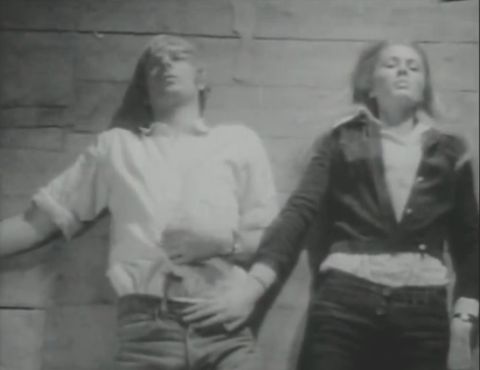
Dink (Berwick Kaler) is a young homeless man who is stumbling through the streets of London, feeling very sorry for himself. When he throws up onto the pavement a young woman, Dee (Julie Shaw) comes over to see if he is all right and starts to look after him, taking him to a nearby cafe for a cup of tea to settle his stomach. They get to chatting, and before long she has invited him over to her flat, which is on the top floor of a rundown block, meeting her friend from down the stairs Ginger (Bill Clancy) on the way. Dink finds him somewhat intrusive, and before long he and Dee are indulging in a passionate affair...
Nightbirds was one of the British films made by cult American horror auteur Andy Milligan, who would be best known for his cheap and not so cheerful shockers, though in this case he appeared to be wishing to create a serious drama, concentrating on the central couple and putting their capricious and none too healthy personalities under his microscope. For much of the film the action, if you could call it that, took place within the four walls of that dilapitated bedsit, which didn't appear to have any heating and only a bed and a stove for furnishings; Milligan really depicted their squalor with a vividness and tangibility.
Though that may have been down to the way they really were filming in squalor, so of course this was going to be conveyed in the seemingly endless scenes of Dink and Dee blowing hot and cold with one another until the inevitable in hindsight downbeat ending. This was only just over an hour and a quarter in length, but felt longer as the scenes crawled by: there was only so much abusive relationship you could take in a movie before it became monotonous, and that was a problem Milligan seemed unwilling to solve, in fact he positively revelled in the sickly bond the two lovers enjoyed, portraying as it did his utterly bleak worldview.
If you'd read a bit about the director, you could see some of his autobiographical touches emerging from his screenplay: Dink, for example, speaks of having run away from his domineering mother, preferring to live on the streets than spend any more time with her, and that was close to the way Milligan felt about his own mother who he credited with having him turn out gay. The portrayal of women certainly contained a suspicion about them; there were no gay characters as far as the script told us (though Ginger might be read that way), but the pessimism about Dink's future with Dee was informed by a disdain for anything approaching a beneficial affair between them.
Dink has an older lady friend in Mabel (Elaine Shore), who as a counterpart to Ginger is just as needy and wanting attention from him, as seen here she seems like a grotesque parody of a blousy woman of a certain age, so in effect we can understand why Dee doesn't like her, and why Dink doesn't like Ginger, it's more than a jealousy and less than a genuine tenderness for their partner. With the to and fro in the passion between the leads there's plenty of scenes of them having sex and being nice to each other contrasted with their arguments and petty irritations which gradually build to a climax, a bit too gradually as the plot, what there is of it, can be repetitive to a wearing degree. We can tell there is doom spelled out when after their first night together a pigeon flies through the skylight, the sort of omen which wouldn't be out of place in Milligan's horrors, but then the ending, which is spurred on by a revelation about Dee leaving us in no doubt she's bad for Dink, has that would-be shock value as well.