They say, when you hear sounds of devils, all else is quiet, or at least that's what Captain Lee Briggs (Bradley Horne) was told some time ago, although he wonders how true that is as he fights in the American Civil War. It could be that proverb is mistaken, but the fact remains he now has the chance to leave the battle for a while and investigate a mysterious object which has landed some distance away from the front lines where he has been engaged. Could there be some connection to another Captain, Lee Miller (Gunner Wright), who lives in the far future as an astronaut?
There could, but not everyone worked out what it was in writer and director William Eubank's science fiction yarn which in some minds was simply ploughing a furrow better exploited by Duncan Jones' similar Moon which arrived around the same time. That observation was not fair, as Eubank had been toiling away on a tiny budget at the same time as Jones had on his cult movie, so any similarities were coincidence, or perhaps more probably thanks to the influences of the respective films. The one both were saddled with was that Stanley Kubrick's 2001: A Space Odyssey was what they were trying to emulate, but equally the inspiration might well have stemmed from Douglas Trumbull's Silent Running.
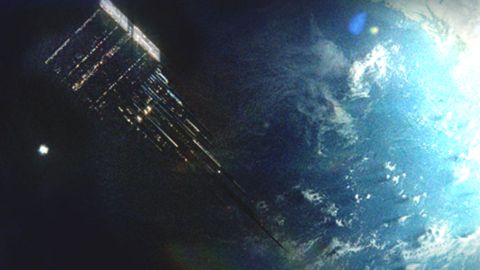
The difference being at least the spaceman in Moon had someone to talk to, and Bruce Dern chatted away to his robots in his movie, whereas Captain Miller has no company but his own. This sad state of affairs arises when, as the first astronaut to board an International Space Station for some while, he is maintaining the place in orbit when all communication between him and mission control stops abruptly. We can perceive why this is as we can see the explosions flashing across the surface of the globe which looms vastly outside the station's windows, and have to surmise that maybe things are not so healthy down there anymore. Now Miller has nothing to do but survive, not knowing if there is any point in doing so now everyone else has gone.
In this isolation Eubank hoped to teach the audience a lesson, though not in a hectoring manner, about how important it was to keep communicating, a fact his protagonist felt all the more sharply when that benefit was taken away from him. As Joni Mitchell once commented, you don't know what you've got till it's gone, and in this movie was a benevolent message about staying in touch and how vital such links were in a somewhat idealistic way which ignored that as much as people can communicate on friendly terms, they can also be pretty diabolical to one another, though thankfully we have not reached the pits of wiping out the Earth's population because we just couldn't get along anymore.
On the other hand, if the denizens of the world had found common ground, they might not have blown themselves up, and on a scale more pertinent to today, they might not be waging wars at all if they could see the significance of watching the planet from space. Eubank said it was Carl Sagan's "Pale Blue Dot" speech given when the image of Earth from the Voyager space probe was beamed back here as it left the solar system, and you can see that cosmic perspective can alter the way we regard our disagreements, which this tried to put across in cinematic form. That they ddin't quite succeed was not for want of trying, it was simply too keen on maintaining that sense of dwindling in the universe through oblique storytelling that few were going to get to grips with, so that once the astronaut went through notably more emotional endurance than Keir Dullea did in 2001 we were stuck with some vague business about alien intelligences which he may or may not be hallucinating as he expires. Nice try, though. Music by band Angels and Airwaves, who funded the production.