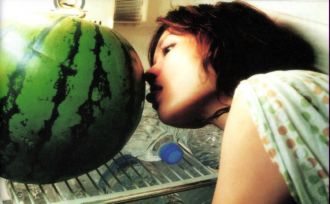
There is a water shortage in Taiwan, which leaves the citizens of Taipei in a difficult position, not least Hsaio-Kang (Lee Kang-shen) and Shiang-chyi (Chen Shiang-chyi) who used to know each other a while ago but haven't met for years. Hsaio now works as a porn actor, and the fact that watermelon is now a staple food in the country due to its abundance, with people drinking the juice of the fruit in lieu of actual water, has worked its way into his videos, as today when he films a scene with a Japanese porn star (Sumomo Yazakura) featuring watermelon in a crucial role...
Oh, and it's a musical as well. The Wayward Cloud was writer and director Tsai Ming-liang's catch up with two characters from his earlier works, taking their relationship to an extreme that appeared to have some pretty uncomfortable things to say about what we can and cannot accept from those we are in love with. There were rumours of walkouts during this film, not because it was boring but because audiences found it offensive, and no wonder when you see what lengths Hsaio has to go to in earning a living, but mostly this was a quirky drama with a large dose of sex spaced at irregular intervals.
Not hardcore, it must be pointed out, as all the sex was simulated, so it was more the concept of what they were up to which was so difficult to take. All the way through from the point that the two would-be lovers meet to the final consummation of their bond there is sexual tension, but not of the variety you would be more accustomed to in a romantic comedy. Yes, comedy, as there were signs that if this were not meant to be an outright bust a gut laugh fest it was in some ways intended to make you chuckle, and not only in the musical numbers which in contrast to the long takes and almost complete lack of dialogue of the sequences in between were bright and exuberant.
Indeed, as the cast lipsynced to various sixties pop records you could observe Tsai would have been better to stick with the style of those, because often this would get so low key it verged on the inert, an irony perhaps given how the story resolved itself. With such questions lingering in the mind as, how does the watermelon crop get so extensive when there's a drought on? there was a sense that we were not intended to regard this as anything other than a representational narrative. But what was it representing? Apparently the emotional bankruptcy of modern love, as those old records illustrated how far we had descended from the ideals of romance to the sex-drenched media we had today.
Not that Tsai was endorsing moralism, indeed he was quite upfront about seeing sex as a natural function, it just that he didn't appear to like the way the more perverted angles in the carnal side of the entertainment industry had corrupted what should be a celebration of humanity. Sounds a tad pretentious, doesn't it? Yet somehow the director got away with it, partly because of his sincerity, partly because of his use of humour and those tune-filled interludes of which he really could have done with more of because seeing the cast cavorting around in wild costumes and with crazy props was highly amusing. Except like the hangover after the party, every time we had one of those interludes the tone would grow more oppressive, leaving the course the plot took for its final act both hard to believe - would the porn industry go to such lengths as necrophilia for their product? - and morally barren. If this is the state modern love is in, then you do worry for the world.