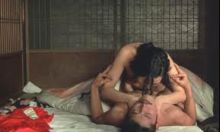
Japan, 1936 and Sada Abe (Eiko Matsudo) has been forced into prostitution thanks to falling on hard times, but now sees a ray of hope when she secures a job as a geisha at the home of wealthy nobleman Kichizo Ishida (Tatsuya Fuji). Although he is married, he considers it his right to have sex with any of his servants as he sees fit, and now he has his eye on Sada because he knows her background. Although she has tried to do her duty for the elderly and frankly past it master of the house, he is too impotent for anything to occur, not something Kichizo has any problem with as her initial reluctance is transformed...
One of the most controversial, most banned movies ever made which also happened to have a very high reputation amiong cineastes, with some declaring it acclaimed director Nagisa Oshima's masterpiece, In the Realm of the Senses continues to evoke debate - a mass debate, you might say - as to how seriously you were meant to take it. Not that Oshima intended it as a joke, he was very sincere indeed, but the inclusion of so much sexually explicit material tended to cheapen it in the minds of many who would have been a lot friendlier towards it should all the shagging and its permutations not been included at all.
Yet on watching it, you had to agree it wouldn't be half the film it was without the sex for it was necessary to illustrate just how all-consuming the passion of the lovers had become, with barely any other aspect of plot getting a look in. We find out very little about the two of them as they are not interested in discussing each other, all that matters is the next bout of sex, and when you know the Japanese title was Ai No Corrida (that's right, where the Quincy Jones song comes from) which meant "Love's Bullfight" then you would be all too aware that things were going to get rather violent sooner or later as the couple become driven by the idea that there is no further they can take their relationship than having one or maybe both of them ending up dead.
Some have seen the repressive, militaristic regime the film takes place in as indication Oshima was making a statement that the eventual perversity of the lovers was a reaction to the twisted nature of their social environment - you could think that, but given there's very little to the movie except Sada and Kichizo obsessing over one another it could be that was merely window dressing and it was the all-consuming affair at the heart of the plot which you were intended to be caught up in. That said, Oshima was not one to shy away from the political side to his work, and the statement that his characters appeared to be making which was essentially nothing else matters once you have found someone to fill your every waking moment was a rejection of society in itself, or at least the consideration of others.
For those who did get to see this in cinemas, there were a number of talking points, but mostly the conversation would be of the "Can you believe that bit where...?!" variety what with the misuse of a boiled egg or Kichizo being so caught up in his sexual frenzy that he picks other partners indiscriminately, including ones who you would have thought, calm down mate, that isn't doing anyone any favours. It was Sada who we are meant to sympathise with, however, as she descends into madness; in another age they would term it nymphomania, but she's difficult to understand entirely when she takes her love to such an extreme. Seeing her playing with a knife may be plot foreshadowing, but she's surprisingly candid about her intentions towards Kichizo, so anything that happens is consensual. As this was based on a true story, with the real Sada becoming an unlikely folk hero at the time, the essentially unknowable quality of someone you watch so intently and in such intimacy was vividly portrayed. Music by Minoru Miki.
[The Criterion Collection release this on Blu-ray with these special features:
Restored high-definition digital transfer of the complete, uncensored version, with uncompressed monaural soundtrack on the Blu-ray edition
Audio commentary from 2009 featuring film critic Tony Rayns
Interview from 2009 with actor Tatsuya Fuji
A 1976 interview with director Nagisa Oshima and actors Fuji and Eiko Matsuda, and a 2003 program featuring interviews with consulting producer Hayao Shibata, line producer Koji Wakamatsu, assistant director Yoichi Sai, and film distributor Yoko Asakura
Deleted footage and U.S. trailer
PLUS: An essay by Japanese film scholar Donald Richie and, for the Blu-ray edition, a reprinted interview with Oshima.]