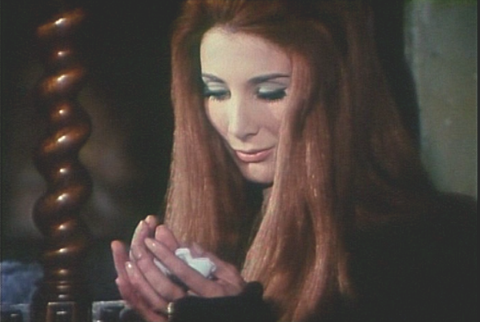
Françoise (Mireille Saunin) and Anna (Michèle Perello) are two students, in philosophy and art respectively, who are driving through the French countryside looking for a place to stay on holiday. Anna mentions she would like to apply her studies to creating comic books, and begins to draw her friend as if in an adventure, little knowing that image may well come true before long. They stop at a tavern but find the locals, all men, none too welcoming, so much so that the innkeeper goes over with their drinks and advises the girls to leave as quickly as possible - not just the tavern, but the entire area.
One of seemingly countless low budget movies around the time the sixties turned into the seventies where an innocent or two would end up at some out of the way country house and either get into some terrible horror story or some elaborate sex game - or possibly both, in some cases - this example was one of the lowest budgeted exercises in that genre. Apparently the money stretched to some colour co-ordinated frocks for the ladies to wear, as it was a mostly female cast as befitting the lesbian theme, though don't go in expecting wall to wall Sapphic lovemaking, for director Bruno Gantillon, graduating from trendy magazine TV, had pretensions here, although precisely what was on his mind was obscure.
To establish the plot, such as it was, the two students end up lost in the darkness having failed to heed the innkeeper's words, and are forced to stay in what they believe is an abandoned cottage for the night. As a hint of what was to come, when they lie back and settle down for sleep, Anna takes it into her head to start kissing Françoise, and before long she's gone even further, not that her buddy is complaining. But there's a question here already: was this Françoise's fantasy, or her dream, or was it really happening? Not a conundrum that is much solved by the conclusion to a film which was oblique in its message, that in spite of acres of talk which you think might be illuminating but ends up confusing matters all the more.
Anyway, morning breaks and Françoise finds herself all alone in the cottage; wondering where Anna has got to, she wanders outside and meets a funny little man called Gurth (Alfred Baillou) who claims to know where her friend has gone, all she need do is follow him to yonder castle and all will be revealed. That's the idea at any rate, but on travelling across the nearby lake on a magical boat (i.e. a normal boat pulled along by an unseen line) she meets the Morgane (Dominique Delpierre) of the title (the original title being Morgane et ses nymphes) who proceeds to give straight answers to none of her enquiries, but is taking a great interest in persuading her to stick around. We soon find out why: all these young women she has hanging around are in her thrall, both sexually and supernaturally.
Once Françoise works this out and is intent on escape, we can begin to ponder exactly what all this was supposed to mean. The women who reject Morgane end up as little old ladies wandering her cellars, so the obvious choice is for the immortality and eternal youth as one of her love slaves, although one would think that would very much depend on how attracted you were to Morgane. Anna meanwhile is revealed to be tied up in a dungeon, having resisted until she sees a chance to save her pal, and you can imagine this was some kind of tract on the jealousy the old have for the young while such sequences as an interpretive dance takes place, reminding bad movie fans perhaps of the Fire Maidens from Outer Space of an earlier vintage. Then there were the lesbian love scenes, though not as many as you'd expect and fairly tastefully done considering what you were watching, Gantillon going for restraint rather than explicitness. Neither one thing nor the other, this was recommended for connoisseurs of po-faced weirdness.