As Lent has arrived once again, the apprentices of this Kiev Seminary are allowed to go home for a holiday, but while their head priest gives the blessing the students are more interested in acting the goat - with a real goat, in some cases. Once dismissed, one novice, Khoma Brutus (Leonid Kuravlyov) accompanies his two friends on their long walk homeward, raucously singing until dusk turns to complete darkness and they realise they are lost. As luck would have it, they stumble across an old farmhouse which appears to be owned by an old woman; she takes some persuading, but eventually agrees to let them stay the night...
Ah, if only they'd taken the option to sleep under the stars as they were going to before the cottage appeared up ahead, then they might not have run into so much trouble. Well, one of them at least, for Khoma bears the brunt of the trouble in this semi-classic horror story from the Soviet era of filmmaking. It was based on a Nikolai Gogol story which in turn had been a Ukranian folk tale and the Eastern European propensity for doing such stories justice was well to the fore, with excellent production design and a cast - which included one of Russia's biggest stars in Kuravlyov - who had a knack for delivering performances which came across as ideal for the material.
Being a folk tale, you'd expect some kind of moral dimension, but the unnerving thing about Viy was the actual motives behind the lead character's persecution remained obscure right up until the last shot, so unless this was a thing peculiar to Ukranians where they could tell you precisely why Khoma was singled out other than his naivety and poor decision making, for everyone else reason was beyond the evil spirits summoned up by his asking for help that fateful night. What happens is that he and his two companions are split up by the old lady to sleep in separate parts of her dwelling, with Khoma in with the animals in the barn. Not that he gets much sleep.
It wasn't all doom and gloom, as first time directors Konstantin Ershov and Georgi Kropachyov appealed to the audience's sense of humour as well, so when the student is trying to settle down and the old woman appears then starts chasing him around the barn he thinks she wants to seduce him, not something he is amenable to. He's laughing it off, yet she is persistent, and when she gets her hands on him it's not sex she's after but something more akin to sorcery, climbing on his back and riding him out of the building and into the countryside, then actually taking flight, soaring above the landscape as the alarmed novice is powerless to resist. When they finally come to rest, he turns on her and beats the crone only for her to transform into a beautiful woman (Romanian actress Natalya Varley).
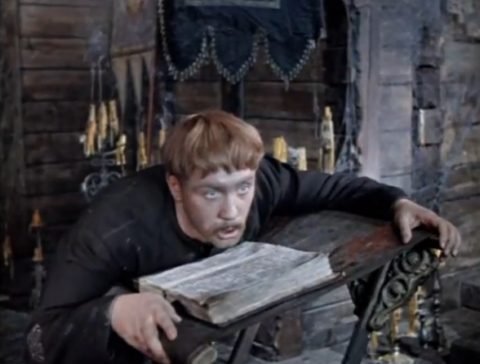
Khoma makes good his escape, but the day of reckoning has not yet arrived - three nights of reckoning, in fact, as he is forced to return to the region he fled and deliver prayers over the body of the woman he now realises he must have killled. Weirdly, the villagers don't seem to know about her witchy alter ego, or perhaps they do and are complicit in the young man's punishment, but all you really need to know is things get truly freaky from now on. You could see why the Soviet authorities would like this tale what with the Church shown up as ineffectual on a regular basis throughout, though what you'll likely most recall would be the invention of the supernatural wrath visited upon Khoma over each night as he cowers in his makeshift chalk circle while the witch does her damnedest to get him. That he cannot get away during the day adds to the nightmarish quality, creating an effective atmosphere of hellish futility and a film which is rightly admired. Music by Karen Khachaturyan.




 Display comments