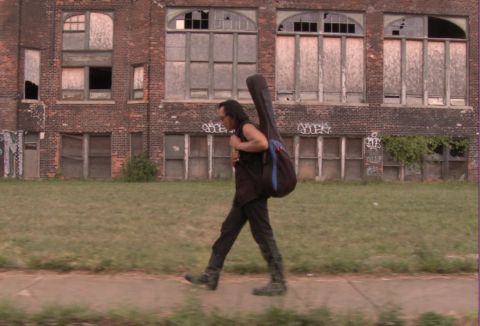
Sixto Rodriguez was one of the biggest stars ever to emerge from the United States... if you were South African, that was, because outside of that nation there were very few that had ever heard of him, not least in his native land where his two albums had sunk without trace in the early seventies. Not only that, but Rodriguez had done the same, and as his form of folk soul took off in South Africa, essential listening for the white liberals in that country who were keen to see the end of apartheid, nobody seemed to know what had happened to this man who made the soundtrack to the underground against the state oppression...
As the documentary form had a big screen renaissance in the twenty-first century, some of the most popular of those efforts came to be the stranger than fiction tales, not necessarily supernatural but more telling of events and stories which if they had been depicted in a fictional context the audience would have found them very hard to believe. One of the best of these was director Malik Bendjelloul's debut Searching for Sugar Man which took a yarn which sounded like a shaggy dog story and portrayed it in the form of a mystery, for after all Rodriguez was a man who had kept a low profile, with the audience unfamiliar with his biography unsure of whether he was even alive.
Unless you were South African in which case this might be old news, yet the purpose of this was not only to relate the subject's unlikely life which it didn't quite get to the heart of, mainly thanks to him staying an enigma after a lot of the questions surrounding him were answered. The other reason for this was to bring some excellent and hitherto overlooked music to a higher profile, which this assuredly did with the sort-of title track of the movie making it onto radio station playlists for the first time in its history, and not only the soundtrack album but Rodriguez's two solo works seeing a jump in sales outside South Africa, though it wasn't difficult to jump from zero, or near enough.
Bendjelloul didn't mention that the musician was fairly popular in Australia and New Zealand as well, but this was more a tale of two cities, Cape Town and Detroit, one where Rodriguez was a megastar, the other where he was a nobody. Inescapably a talking heads format, there nevertheless was enough archive footage to sustain the flow of the unfolding narrative, even if it resorted to old black and white photographs with the tunes played over them and even computer animation to paper over some of the gaps in the available material. Really this story did not begin with the construction worker who happened to be a singer in a Detroit club in 1969 attracting the attention of major record labels for his soul Bob Dylan sound, but with those who took that to heart.
As with much of this, the actual reason the music of Rodriguez arrived in South Africa was difficult to track down, with one interviewee and champion of the Cold Fact album, Steve Segerman, claiming to have heard it stemmed from a girl bringing back it back from the States and it taking off in bootleg form, though nobody knew for sure. Then there was the alarming rumour that the singer had taken his attempt at a comeback rather badly and killed himself onstage in dramatic fashion: whatever, the South African fans were fairly convinced he was dead. That this music was the perfect complement to standing up to the police state in that nation of the time was something you came away with, but that was only half the story, and Searching for Sugar Man was one of those films where the less you knew the better; suffice to say as music documentaries went, this was undoubtedly one of the most uplifiting and gratifying entries into a crowded field, and cause for optimism if you allowed that.