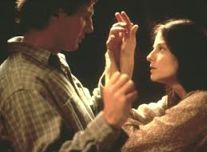
The forests of North Carolina, and today when the delivery man (Jeremy Davies) arrives at this remote cabin to drop off the owner's groceries there doesn't seem to be anyone about. He ventures into the place and is alarmed to see the old woman lying dead on the floor with daisies on her eyes, so he races back into town and alerts Sheriff Todd Peterson (Nick Searcy), who in turn contacts local doctor Jerome Lovell (Liam Neeson). When they investigate the cabin, they work out that the body has been prepared after death - but by whom?
How about someone who really went back to nature in a big way, the old lady's daughter Nell, played by Jodie Foster in one of the most naked attempts, in more ways than one, to secure an Oscar of the nineties. She was nominated, but didn't win probably because no matter how technically proficient she was they don't hand out Academy Awards to performers speaking Klingon. Nell has her own special language, so all the way through the star chuntered away in a manner both meticulously worked out and deeply silly, all in the service of a plot which adopted a treehugging attitude to Mother Nature by celebrating the protagonist's supposed innocence.
There were two types of fan for this movie, one was the sort who took it all at face value and bought into the drama, the other was the sort who championed it as a camp classic thanks to Foster's unbelievably mannered performance. Once Lovell has been made aware of her presence, she becomes his pet project and he teams up with behavioural psychologist Paula Olsen (Natasha Richardson) to try to fathom what this woman's background was and more importantly, how they can help her. This is such an artificial premise that you can be forgiven for not taking it seriously, one of those movie constructs where it wishes to teach you a heavily sincere lesson but can only do so in a patronising way.
Therefore Nell is held up as a paragon of natural virtue and the nasty people who live in buildings bigger than her cabin with an electricity supply are somehow lesser mortals by comparison, a phoney baloney fantasy of keeping in touch with your environmental concerns as a purer method of living. To illustrate this, Lovell and Olsen achieve some kind of awakening themselves: you couldn't have him fall in love with Nell because that would be creepy (though not half as creepy as the electronic surveillance he places her under, all for science you understand) so it's Paula who he gets close to over the course of would-be heartstring-tugging melodrama. By this time Nell is learning English and he is cottoning onto her language, so she graduates to sounding like one of the Teletubbies.
Predictably her idyll cannot last forever, and soon the modern world is encroaching taking the form of the hicks in the nearby town menacing her, the media then taking an interest to Nell's panic, and finally the big bad medical establishment determine to put her in an institution as they don't accept she can look after herself. They may have a point: the actual details of her day-to-day survival remain hazy, so we don't find out where she gets her food from now, nor for that matter when or how she learned to shave her legs, but anything like that would have broken the spell the filmmakers were keen to cast. Not that it's much of a spell, and after the novelty wears off this looks incredibly condescending to everyone, characters and audience, so by the point of the courtroom finale where Nell offers an account of herself in a manner not unlike Jar Jar Binks you may well have given up on proceedings. Perhaps if they had made more of a fantasy of it this might have satisfied, but Jodie as Tarzan would have probably been a step too far. Music by Mark Isham, heavy on the plaintive flute.